
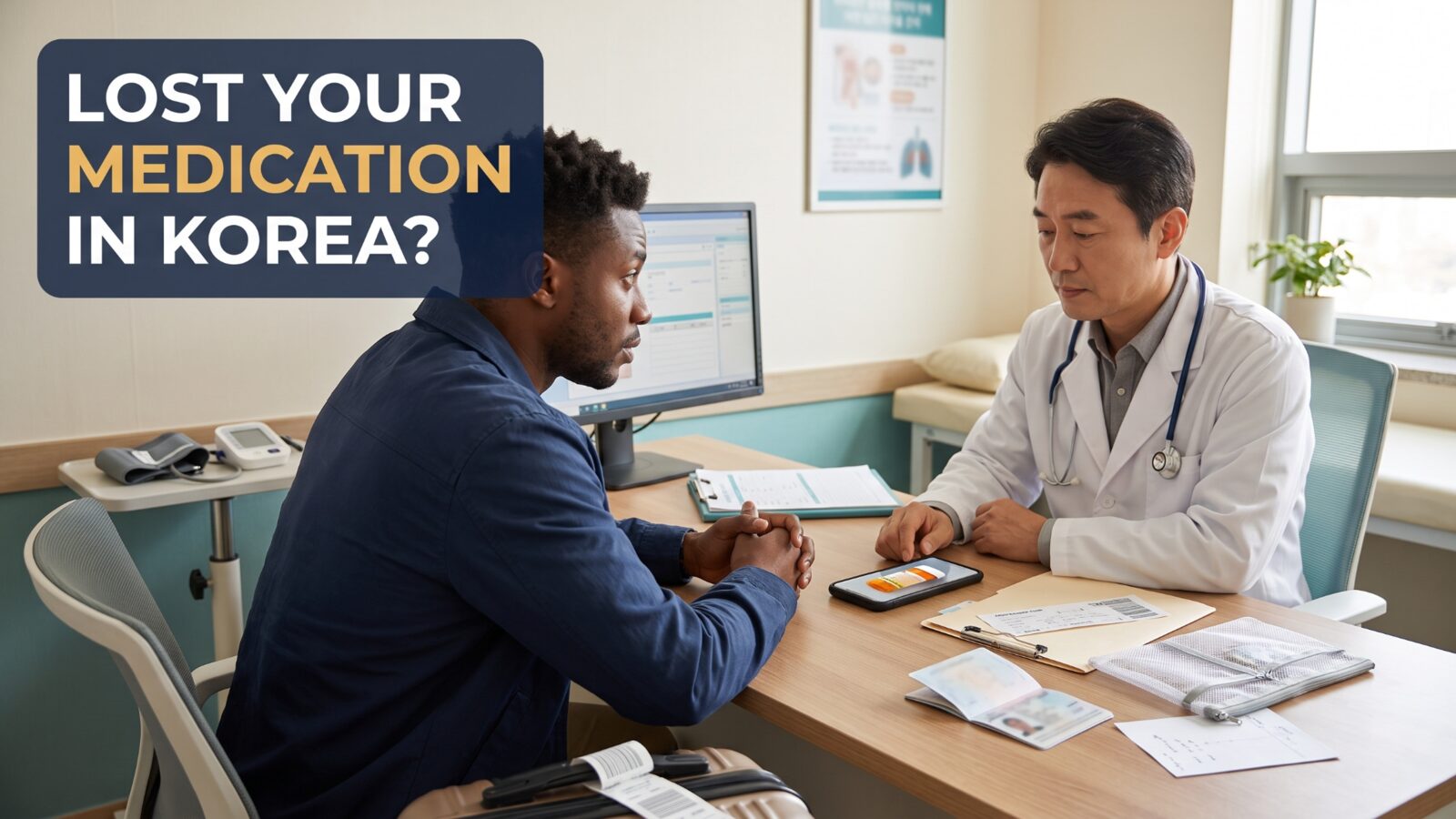
Your suitcase never arrived.
Your blood pressure tablets, thyroid medication, insulin or seizure medicine are inside—and you may not have enough doses left for tomorrow.
Can you show a photograph of the bottle at a Korean pharmacy and buy the same medicine?
Sometimes a pharmacist can help with an over-the-counter product. But if you have lost medication in Korea that requires a prescription, the usual solution is not a simple pharmacy refill.
You will generally need a Korean doctor to review your medical information and issue a prescription that can be used at a Korean pharmacy.
The process is manageable, but the order matters.
Quick Answer
If you lose prescription medication in Korea, collect as much evidence as possible—including a photograph of the package, the generic ingredient, dosage, prescription and medical records—and visit an appropriate clinic.
A foreign prescription can help explain your treatment, but you should not assume that a Korean pharmacy can dispense prescription-only medicine directly from it.
A Korean doctor may need to assess your condition and issue a locally usable prescription. The exact brand may not be available, but an equivalent medicine with the same active ingredient may sometimes be considered.
If missing a dose could be dangerous, seek medical help immediately rather than waiting for your luggage.
First: Decide How Urgent the Situation Is
Not every missed dose has the same risk.
Losing a routine medicine that can safely wait until the next morning is different from losing insulin, antiseizure medication, an anticoagulant, transplant medicine or another drug whose interruption may cause serious harm.
Seek same-day medical advice when:
- You have no doses remaining
- You have already missed an important dose
- You use insulin or medicine for seizures
- You take anticoagulants or transplant medication
- Your medicine must not be stopped suddenly
- You are unsure whether delaying a dose is safe
- You are beginning to develop symptoms
Call 119 or go to an emergency room if you develop severe symptoms such as difficulty breathing, chest pain, loss of consciousness, a seizure, severe confusion or another medical emergency.
Do not take someone else’s medicine or change the dose to make your remaining supply last longer without professional advice.
What to Collect Before Visiting a Korean Doctor
The doctor needs to identify both your medical condition and the exact product you were taking.
Collect whatever you can find:
- A photograph of the medicine package or bottle
- The generic or active ingredient name
- Brand name
- Strength, such as 5 mg or 100 mg
- How many times you take it each day
- Whether it is extended-release or immediate-release
- Your diagnosis
- A copy or photograph of your prescription
- A medication list from your hospital app
- Recent medical records or laboratory results
- The name and contact details of your regular doctor
- Known allergies
- Other medicines and supplements you take
A photograph of the front of the package may not be enough. The active ingredient and dosage are usually more useful than the brand name.
If the medicine was inside delayed baggage, save the airline’s baggage report. If it was stolen, a police report may be helpful for an insurance claim.
Where Should You Go?
For many common chronic conditions, a local internal medicine clinic—called 내과 in Korean—is a reasonable first stop.
Internal medicine clinics commonly manage conditions such as:
- High blood pressure
- Diabetes
- Thyroid disorders
- High cholesterol
- Common respiratory conditions
- Many routine adult medical problems
A specialist or larger hospital may be more appropriate if you have a complex condition, use a highly specialized medicine or need close monitoring.
Examples include:
- Organ transplant treatment
- Cancer medication
- Rare diseases
- Complex heart conditions
- Certain psychiatric medicines
- Controlled substances
- Medicines requiring blood tests or special monitoring
If you are uncertain whether to visit a clinic, hospital or pharmacy, read our Korean Pharmacy or Hospital guide.
For the usual registration and payment process, see How to Visit a Clinic in Korea as a Foreigner.
Can a Korean Pharmacy Use Your Foreign Prescription?
Do not assume that an American or other foreign prescription can be filled directly at a Korean pharmacy.
It is still valuable evidence. It can show the doctor or pharmacist:
- What medicine you normally take
- Why it was prescribed
- The dosage and schedule
- How recently it was prescribed
- Who prescribed it
However, prescription-only medicine in Korea generally requires an appropriate prescription before a Korean pharmacy can dispense it. Article 50 of Korea’s Pharmaceutical Affairs Act distinguishes between over-the-counter and prescription-only medicine.
The practical route is usually:
- Visit a Korean clinic or hospital.
- Show the doctor your prescription and medical evidence.
- Receive a medical assessment.
- Obtain a Korean prescription if the doctor determines that the medication is appropriate.
- Take the prescription to a pharmacy.
The doctor is not simply copying your overseas prescription. The doctor remains responsible for deciding whether the medicine, dosage and duration are medically appropriate.
Will You Receive the Exact Same Medicine?
Not necessarily.
The same brand may not be sold in Korea. It may have a different Korean brand name, package size or manufacturer.
In some cases, a Korean doctor may consider a product containing the same active ingredient. But several details must still be checked:
- Strength
- Dosage form
- Extended-release versus immediate-release formulation
- Combination ingredients
- Approved uses in Korea
- Possible interactions
- Storage requirements
Two products with similar names are not automatically interchangeable.
This is especially important for insulin, seizure medicine, hormones, anticoagulants and modified-release products. Do not substitute a product based only on an internet search or packaging photograph.
The doctor and pharmacist should confirm whether an appropriate Korean equivalent exists.
What If the Medicine Is Available Without a Prescription?
Some medicines are classified as over-the-counter products in Korea and may be sold after consultation with a pharmacist.
However, a medicine that is available without a prescription in another country may be classified differently in Korea.
Start by showing the pharmacist:
- The active ingredient
- Dosage
- Package photograph
- Your medical condition
- Other medicines you take
- Allergy information
Our guide to medicine in Korea without a prescription explains the difference between Korean over-the-counter and prescription-only products.
Do not try to replace an important chronic medication with an over-the-counter product merely because the packaging or purpose appears similar.
Controlled Medicines Require Extra Caution
ADHD medication, opioid pain medicine, some anxiety or sleep medicines and other controlled substances can be significantly more complicated.
The medicine may:
- Be regulated differently in Korea
- Require additional documentation
- Be unavailable under the same brand
- Contain an ingredient that is tightly controlled
- Require assessment by a particular type of doctor
Do not ask a friend or family member to mail or carry additional controlled medication into Korea without checking the rules first.
The Korean Ministry of Food and Drug Safety states that travelers bringing medicines containing controlled narcotic or psychotropic substances for personal treatment must obtain prior approval, regardless of nationality. See the MFDS controlled-medicine guidance.
That import approval process is different from receiving treatment after medication has already been lost in Korea. In an urgent situation, contact a Korean medical provider, your regular doctor and your insurer rather than attempting an unverified international shipment.
Can You See a Doctor Without Korean Insurance?
Yes.
Foreign visitors can generally receive medical care in Korea without Korean National Health Insurance, but they may need to pay the clinic and pharmacy directly.
Costs depend on the medical institution, examinations, tests and medicine required.
Read Can You See a Doctor in Korea Without Insurance? for more information about self-payment and international insurance.
Before leaving the clinic, ask for:
- Medical receipt
- Itemized statement
- Prescription
- Medical certificate or visit note, if required
- Documents for travel insurance
Keep the pharmacy receipt separately because clinic and pharmacy payments are normally made at different locations.
Your travel insurance company may also want the delayed-baggage report, police report or proof that the original medication was lost.
Useful Korean Sentences
I lost the medicine I normally take.
복용하던 약을 잃어버렸어요.
Bogyonghadeon yageul ireobeoryeosseoyo.
My luggage did not arrive.
수하물이 도착하지 않았어요.
Suhamuri dochakhaji anasseoyo.
I need medicine with the same active ingredient.
같은 성분의 약이 필요해요.
Gateun seongbunui yagi piryohaeyo.
It may be dangerous if I stop taking this medicine suddenly.
이 약을 갑자기 중단하면 위험할 수 있어요.
I yageul gapjagi jungdanhamyeon wiheomhal su isseoyo.
This is a photograph of my prescription.
제 처방전 사진입니다.
Je cheobangjeon sajinimnida.
Show the sentences on your phone if pronunciation is difficult.
Frequently Asked Questions
Can a pharmacist replace my lost prescription medicine?
A pharmacist may help identify the product and advise you about the next step. However, if the medicine is prescription-only in Korea, you will generally need an appropriate prescription before it can be dispensed.
Can a Korean doctor prescribe the same medicine after seeing a photograph?
A photograph is useful but does not guarantee a prescription. The doctor may need additional information about your diagnosis, dosage, allergies, other medicines and medical history. The exact brand or formulation may also be unavailable in Korea.
Should I go to an emergency room?
Not every lost medication requires emergency-room care. A local clinic may be sufficient when you are stable. Seek urgent care when missing the medicine could cause serious harm, you have already developed concerning symptoms or you cannot obtain timely help elsewhere.
Korea Compass Note
Medication replacement is not simply a shopping problem.
A familiar brand from home may have a different name, classification or formulation in Korea. The safest solution is to identify the active ingredient, show reliable medical evidence and allow a Korean doctor and pharmacist to determine an appropriate replacement.
If the medicine is essential, act before the final dose is gone.
Final Thoughts
Lost luggage is frustrating. Losing essential medicine can turn it into a medical problem.
The safest sequence is straightforward:
Gather your medication information, assess the urgency, visit an appropriate Korean clinic and take the locally issued prescription to a pharmacy.
Your foreign prescription, medication photograph and medical records can make the process faster, but they do not guarantee that the identical product will be dispensed.
The earlier you ask for help, the more options you are likely to have.