
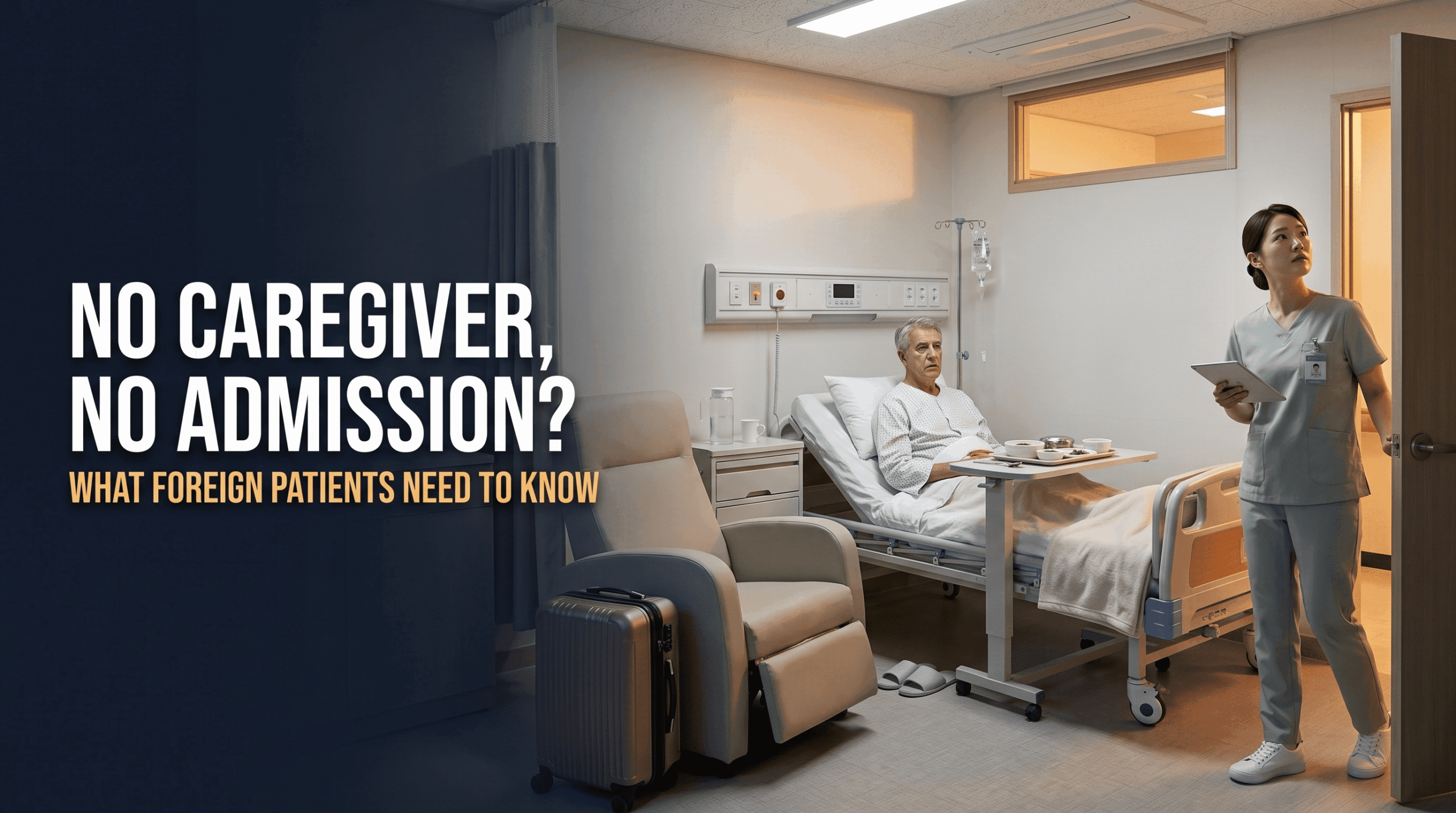
A hospital bed may be available. A caregiver may not be.
A caregiver in a Korean hospital may be essential when a patient cannot manage everyday bedside needs alone.
In many countries, patients assume hospital staff will handle almost everything after admission. Korea can work differently.
Nurses provide medical care, but help with meals, toileting, walking, repositioning and staying with a vulnerable patient may still fall to family members or a privately hired caregiver—unless the patient receives a bed in an integrated nursing-care ward.
For a foreign patient arriving without family, arranging a caregiver in a Korean hospital can become one of the most important parts of admission. Finding an English-speaking caregiver at short notice can be especially difficult.
Nurses in a general ward provide medical and nursing care, but continuous one-to-one assistance with daily activities is not automatically included. If the patient cannot manage independently and family members cannot remain at the hospital, a private caregiver can become essential.
This is not a problem faced only by foreign patients. Many Korean families also hire caregivers because spouses and adult children work, live far away or have young children to care for at home.
Quick Answer
You do not always need a private caregiver during a hospital stay in Korea.
Patients admitted to an integrated nursing and caregiving ward receive nursing and daily living support from the hospital’s care team without a family member or private caregiver staying in the room.
However, these beds are limited and are not automatically assigned. Availability depends on the hospital, department, patient’s condition and available beds.
If the patient is placed in a regular ward and needs help eating, washing, walking or using the toilet, the family may need to arrange a private caregiver.
Three Different Hospital Care Arrangements
| Type of ward or care | Who provides daily assistance? | What patients should know |
|---|---|---|
| Regular hospital ward | Family member or private caregiver may assist | One-to-one personal care is not automatically included |
| Integrated nursing and caregiving ward | Nurses, nursing assistants and care-support staff | Private caregivers are generally unnecessary, but beds are limited |
| Private caregiver | A caregiver hired by the patient or family | Usually arranged separately and paid out of pocket |
Before admission, ask the hospital exactly which arrangement applies to you.
Why Private Caregivers Are Common in Korea
Private caregiving is not mainly a service for foreign patients. Korean families also rely heavily on caregivers during long hospital stays.
In many households, both spouses work. Adult children may be unable to stop working to remain beside an older parent for several weeks. Other family members may need to care for children or older relatives at home.
A short hospital visit may be manageable without additional help. A long admission following surgery, a stroke, a serious injury or declining mobility can be very different.
The Bank of Korea estimated the average monthly cost of private caregiving at approximately KRW 3.7 million. That was about 1.7 times the median income of households headed by someone aged 65 or older.
For some families, a prolonged hospital stay creates not only a medical crisis but also a financial one.
What Does a Private Caregiver Actually Do?
A caregiver primarily provides non-medical assistance with daily life. Depending on the patient’s condition and the agreed scope of work, this may include:
- Assisting with meals and drinking water
- Helping with washing, grooming and changing clothes
- Assisting with toileting or changing an adult brief
- Helping the patient stand, walk or use a wheelchair
- Repositioning a patient who cannot move independently
- Watching for falls or sudden discomfort
- Calling the nurse when medical assistance is needed
- Providing companionship during a long admission
A private caregiver is not a doctor or nurse. The caregiver should not make diagnoses, change an IV, decide medication doses or perform medical procedures outside their authorized role.
Integrated Nursing Care May Remove the Need for a Private Caregiver
Korea’s Integrated Nursing and Caregiving Service was created so patients could receive hospital care without a family member or private caregiver remaining in the room.
The service includes help with personal hygiene, meals, mobility and repositioning, as well as nursing care provided by a hospital team.
However, patients should not assume that an integrated ward will be available.
The Korean government reported that 822 medical institutions and 88,736 beds participated in the program in 2025. This represented approximately 35% of eligible hospital beds, despite continued expansion.
Integrated wards are popular with Korean patients because they reduce both the burden on families and the cost of hiring a private caregiver. Patients should request one as early as possible, but an early request still does not guarantee placement.
You can search for participating hospitals through the National Health Insurance Service hospital finder.
English-Speaking Caregivers Are Difficult to Find
English ability is not a standard qualification for private caregivers in Korea, and there is no reliable national database of English-speaking caregivers.
Foreign patients should never assume that an available caregiver can communicate comfortably in English.
Ask the hospital’s international center or caregiver agency to confirm the caregiver’s actual language ability before admission. Make the request as early as possible because the number of suitable caregivers may be limited.
A caregiver may help with simple daily communication, but should not replace a qualified medical interpreter when discussing:
- Medical consent
- Diagnosis and treatment
- Medication instructions
- Surgery or anesthesia
- Discharge instructions
- Changes in the patient’s condition
For help communicating with hospital staff, contact the hospital’s international center. Our guide to choosing an international clinic in Korea explains what assistance foreign patients can expect.
Who Should Seriously Consider Arranging a Caregiver?
A private caregiver may be particularly important when:
- The patient cannot eat, wash or use the toilet independently
- The patient has difficulty walking or has a high risk of falling
- Major surgery will limit mobility
- The patient needs assistance during the night
- The patient has dementia, delirium or significant confusion
- No integrated nursing-care bed is available
- Family members live overseas or cannot remain at the hospital
- A spouse or adult child must continue working
- Family members need to care for young children at home
Patients who are mobile, independent and admitted for a relatively minor procedure may not require one. The decision should be based on the patient’s actual needs and the services provided by the assigned ward.
Questions to Ask Before Admission
Ask the hospital or international patient coordinator:
- Does this hospital have an integrated nursing and caregiving ward?
- Can I request that type of bed before admission?
- What happens if an integrated-care bed is unavailable?
- Does the hospital recommend or arrange private caregivers?
- Can you locate a caregiver who speaks English?
- What duties will the caregiver perform?
- Is the caregiver assigned one-to-one or shared with other patients?
- What are the daily rate, additional charges and cancellation rules?
- Who provides medical interpretation?
If you are unfamiliar with the admission process, read our guide to using a hospital in Korea as a foreigner.
How Much Does a Private Caregiver Cost?
Caregiver charges vary according to the patient’s condition, working hours, one-to-one or shared care, and the agency providing the service.
Private caregiving is often contracted directly by the patient or family rather than included in the hospital bill. Insurance coverage also varies, so do not assume that travel or international health insurance will reimburse the cost.
Before agreeing, request written confirmation of:
- Daily or hourly charges
- Overnight and holiday surcharges
- One-to-one or shared assignment
- Meals and other expenses
- Replacement arrangements
- Payment method and receipts
- Cancellation and refund rules
The Korean government has acknowledged the scale of this burden. The Ministry of Health and Welfare previously estimated that annual private caregiving expenses had exceeded KRW 10 trillion.
The government is expanding integrated nursing care and planning additional support for selected long-term care hospitals. However, these policies do not yet mean that every hospital patient can receive publicly supported caregiving.
Frequently Asked Questions
Is a caregiver legally required for hospitalization in Korea?
No. A private caregiver is not legally required for every patient. The need depends on the ward, the patient’s independence and whether family support or integrated nursing care is available.
Can a nurse provide all the help a caregiver would provide?
In an integrated nursing and caregiving ward, the hospital team provides both nursing and daily living assistance. In a regular ward, continuous one-to-one personal support may not be available.
Can the hospital arrange an English-speaking caregiver?
Some international centers or caregiver agencies may be able to help, but availability is limited. Request one early and confirm the person’s actual English ability before accepting the assignment.
Korea Compass Note
The most important time to discuss caregiving is before admission, not after the patient is already in the room.
Ask two questions first:
Is an integrated nursing and caregiving bed available?
If not, will this patient need a private caregiver?
A clear answer can prevent family disruption, communication problems and a major unexpected expense during an already stressful hospital stay.