
In May 2026, a Moroccan father and his two adult sons traveled more than 10,000 kilometers to Seoul for a complex living-donor liver transplant.
It is a remarkable story—but one hospital’s success story alone does not prove that an entire country leads the world.
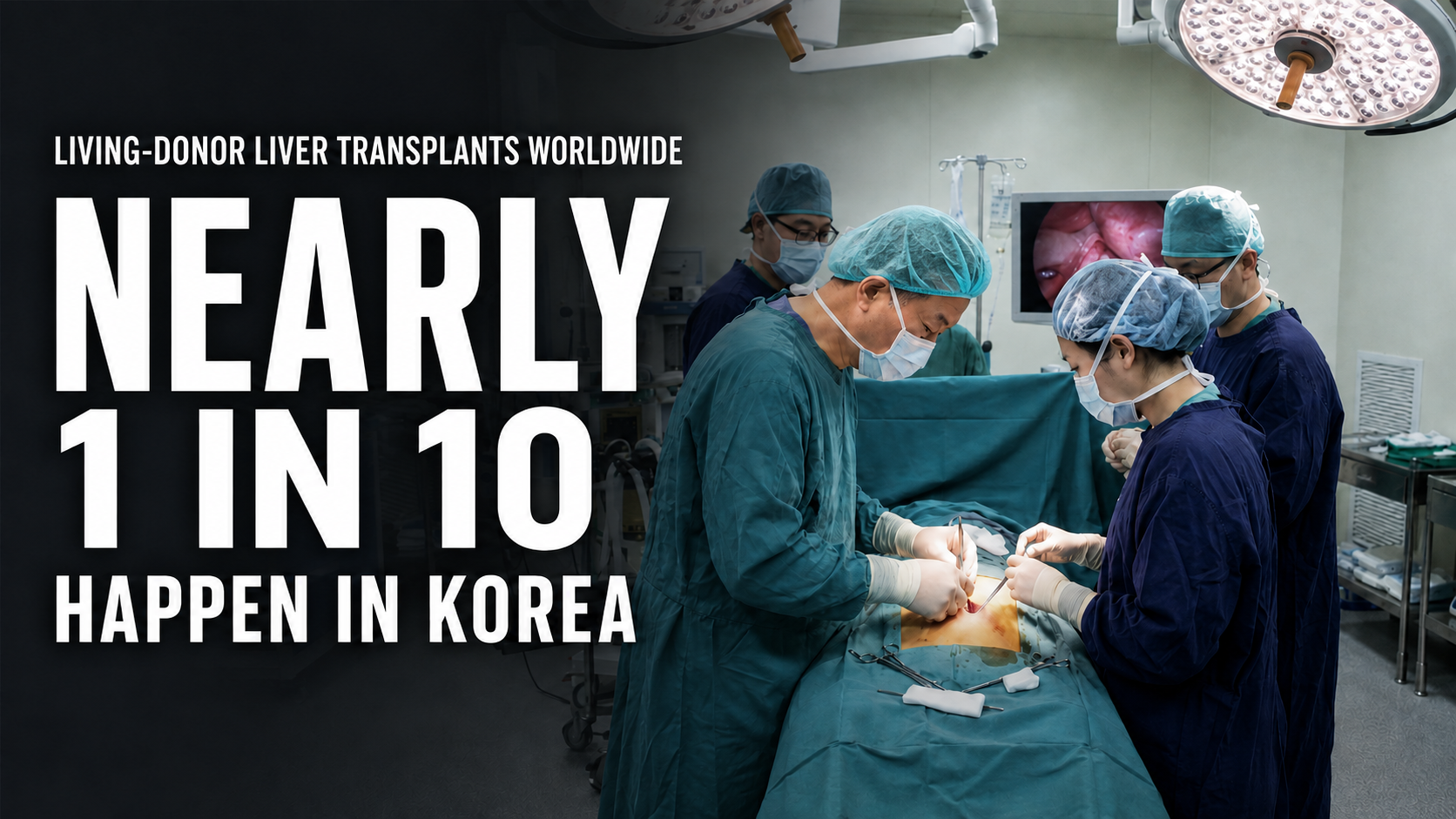
The national and global numbers provide stronger evidence. In 2024, South Korea performed approximately 9.3% of all reported living-donor liver transplants worldwide. Put simply, nearly one in every ten took place in Korea, despite the country accounting for only a small fraction of the world’s population.
What does that number actually mean? And can a foreign patient realistically receive a liver transplant in Korea?
Quick Answer
Yes, foreign patients have received living-donor liver transplants in Korea. In 2024, Korea performed 920 living-donor liver transplants—approximately 9.3% of the estimated global total, or nearly one in ten.
However, this is not a procedure that a medical traveler can simply book. The recipient and donor must undergo extensive medical evaluation, relationship and document verification, ethical review, and approval under Korea’s transplant system. Current nationwide statistics do not separately disclose how many of Korea’s annual liver-transplant recipients are foreign nationals.
In This Guide
- Korea’s share of global liver transplantation
- Why living donation is so important in Korea
- How many foreign patients have received transplants
- What Korean hospitals require from overseas families
- What the numbers do—and do not—prove
The Number Behind Korea’s Reputation
The latest complete global comparison is based on 2024 data.
The Global Observatory on Donation and Transplantation reported 42,497 liver transplants worldwide that year. Approximately 23% used organs from living donors, equivalent to about 9,800 living-donor procedures.
South Korea recorded 1,262 liver transplants in 2024:
| 2024 liver-transplant data | Number |
|---|---|
| Liver transplants reported worldwide | 42,497 |
| Living-donor liver transplants worldwide | 9,861 |
| Total liver transplants in South Korea | 1,262 |
| Living-donor liver transplants in South Korea | 920 |
| Deceased-donor liver transplants in South Korea | 342 |
| Korea’s share of all global liver transplants | About 3.0% |
| Korea’s share of global living-donor liver transplants | About 9.3% |
This means Korea performed nearly one in every ten living-donor liver transplants reported worldwide in 2024.
Living donors accounted for about 73% of Korea’s liver transplants that year, compared with approximately 23% globally.
Korea’s 2025 country data shows that living-donor liver transplantation increased again to 1,014 procedures. A complete global comparison for 2025 is not yet available, so the “nearly one in ten” calculation uses the complete 2024 datasets.
The global figures come from the Global Observatory on Donation and Transplantation, while the Korean figures can be checked through IRODaT’s South Korea database and Korea’s official organ-donation and transplantation statistical reports.
Why Does Korea Perform So Many Living-Donor Transplants?
Korea’s expertise did not develop simply because hospitals decided to specialize in an impressive operation.
It developed partly because deceased-donor organs have remained scarce.
Korea recorded 7.68 deceased organ donors per million people in 2024. This was far below the rates reported in countries such as the United States and Spain.
With fewer deceased-donor livers available, Korean transplant teams had to develop other ways to help patients with end-stage liver disease.
Living-donor transplantation became a central part of that response.
In a living-donor liver transplant, a healthy donor gives part of the liver to the recipient. The donor’s remaining liver and the transplanted portion can regenerate, although donation is still major surgery and involves real medical risk.
Over several decades, Korean teams developed extensive experience in:
- Adult-to-adult living-donor transplantation
- Right-lobe liver grafts
- Blood-type-incompatible transplantation
- Minimally invasive donor surgery
- Dual-graft transplantation using portions from two donors
- Complex vascular reconstruction
- Long-term donor and recipient management
This combination of necessity, surgical volume, specialized teams, and technical innovation helped Korea become unusually experienced in living-donor liver transplantation.
How Many Foreign Patients Receive Liver Transplants in Korea?
This is where the available data becomes less complete.
Korea publishes national totals for living- and deceased-donor transplantation, but the latest annual public tables do not provide a clear separate count of foreign liver-transplant recipients.
The most useful nationwide foreign-patient data currently available is older.
Data submitted to a Korean National Assembly member showed that foreign nationals received 410 organ transplants in Korea between January 2013 and September 2018. Of these, 210 were liver transplants.
The same dataset reported that:
- 363 of the 410 foreign-recipient procedures involved living donors
- 47 involved deceased donors
- Foreign nationals represented about 2% of all transplant recipients during that period
- Living-donor transplants involving foreign recipients represented about 3.1% of living-donor organ transplants
These figures cover all organ types and include foreign nationals with different residence circumstances. They should not be treated as the current annual number of international medical travelers.
The important conclusion is more limited:
Foreign nationals have received liver transplants in Korea, but there is no sufficiently current public national dataset showing exactly how many foreign patients receive them each year today.
That limitation should be stated openly rather than filled with an estimate.
What a Study of Overseas Patients Found
A peer-reviewed study provides a closer look at overseas patients who traveled to Korea for living-donor liver transplantation.
Researchers reviewed 3,401 living-donor liver transplants performed at Asan Medical Center between 2010 and 2019. Among them, 105 recipients were overseas non-Korean patients, representing 3.1% of the center’s living-donor procedures during the study period.
The study found that:
- 95 patients were adults and 10 were children
- 83.8% came from the United Arab Emirates or Mongolia
- Recipient and donor selection standards were the same as those used for Korean patients
- The most frequent adult donors were the recipients’ sons and daughters
- Overall patient survival was 96.2% at one year
- Overall patient survival was 92.4% at three and five years
These are encouraging results, but they come from one highly experienced center and from a carefully selected group of patients. They do not guarantee the same outcome for every diagnosis, hospital, donor, or recipient.
The complete study is available through the Korean Society for Transplantation research database.
Can a Foreigner Get a Liver Transplant in Korea?
Yes—but the realistic pathway for an overseas medical patient is usually a living-donor transplant involving an appropriately verified donor.
A foreign patient cannot arrive in Korea, pay for surgery, and receive an unidentified or purchased organ.
A legitimate transplant program must protect both the recipient and the donor and prevent organ trafficking or financially motivated donation.
The hospital will generally need to establish that:
- The recipient medically requires transplantation
- The recipient is medically able to undergo major surgery
- The proposed donor is healthy enough to donate
- The graft will be large and anatomically suitable enough
- The relationship between donor and recipient is genuine
- The donor is acting voluntarily
- No organ sale or improper financial arrangement is involved
- Required documents can be authenticated
- Korea’s transplant approval requirements are satisfied
- Safe postoperative and long-term follow-up can be arranged
The exact documents and approval process depend on the case, nationality, family relationship, hospital, and current Korean regulations.
A short-term medical traveler should also not assume that joining Korea’s deceased-donor waiting list is an available alternative. Deceased organs are distributed through Korea’s regulated national allocation system according to eligibility, medical urgency, blood type, waiting status, and other official criteria.
What the Donor Must Go Through
The donor is not simply tested for blood type.
A living liver donor may undergo:
- Blood and infectious-disease testing
- CT or MRI evaluation of liver anatomy
- Liver-volume measurement
- Fatty-liver assessment
- Heart and lung evaluation
- Psychological or psychiatric assessment
- Review of the family relationship
- Independent confirmation of voluntary consent
- Surgical-risk counseling
- Review under institutional and national transplant procedures
A donor may be rejected even when they sincerely want to help.
Possible reasons include unsuitable liver anatomy, insufficient remaining liver volume, significant fatty liver, an underlying medical condition, psychological concerns, or unacceptable risk to the donor.
The recipient’s need does not override the donor’s safety.
A Recent Case Shows What Complex Surgery Can Involve
The Moroccan family that traveled to Seoul in 2026 illustrates why some overseas patients consider Korea.
The 64-year-old father had end-stage liver disease and advanced liver cancer. Because a single donor graft was not expected to provide enough liver volume, his two adult sons each donated a portion of their liver.
According to the hospital’s report, the three operations were coordinated across multiple operating rooms and took approximately 17 hours. One son’s blood type was incompatible with his father’s, adding another layer of complexity.
The procedure used a dual-graft technique first developed in Korea for situations in which one donor graft may be too small—or removing a larger portion from a single donor could place that donor at greater risk.
This was an extraordinary case, not a standard treatment package. The hospital’s own account can be read in the Asan Medical Center newsroom.
Its value is not that every foreign patient should choose the same hospital. It shows the type of complex living-donor work that helped build Korea’s international reputation.
What Korea’s High Volume Does Not Prove
High surgical volume is meaningful, but it should not be turned into a blanket promise.
The data does not prove that:
- Korea is automatically the best country for every patient
- Every Korean hospital has the same transplant experience
- Every patient will be accepted
- Every donor will be suitable
- Surgery will be successful
- Complications will not occur
- Treatment will be inexpensive
- Overseas insurance will cover the procedure
- Follow-up can be completed entirely from another country
Liver transplantation is one of the most complex forms of medical care. Outcomes depend on the patient’s diagnosis, cancer stage, severity of liver failure, infections, other medical conditions, donor suitability, surgical team, intensive care, medication management, and long-term follow-up.
The best center is the one that can evaluate the specific recipient and donor safely—not simply the institution with the largest number on its website.
What Foreign Families Should Ask Before Sending Records
For a case this serious, contact a hospital’s international healthcare center rather than using an ordinary online appointment form.
Ask:
- Does the hospital accept overseas patients for living-donor liver transplantation?
- Which medical records must be reviewed first?
- Are certified translations required?
- What donor relationships can be considered?
- How is the relationship verified?
- Can the recipient and donor be screened before traveling?
- How long must both people remain in Korea?
- Who manages complications after returning home?
- Can the Korean team communicate with the patient’s local hepatologist?
- What does the written estimate include?
The estimate should distinguish costs for:
- Recipient evaluation
- Donor evaluation
- Surgery and anesthesia
- Intensive care
- Hospital rooms
- Medication
- Blood products
- Additional procedures
- Complication management
- Donor follow-up
- Recipient follow-up
- Interpretation and international coordination
- English medical records
For most short-term overseas patients, this will be planned self-pay treatment unless an insurer, government program, or other payer confirms coverage in writing.
Important: This Is Not Ordinary Medical Tourism
Traveling for legitimate living-donor transplantation is fundamentally different from buying access to an organ.
Patients should avoid any person or company that:
- Offers an anonymous donor
- Requests payment directly for an organ
- Promises approval without medical review
- Suggests hiding the true donor relationship
- Guarantees a transplant date before evaluation
- Refuses to identify the transplant hospital and physicians
- Cannot explain the legal and ethical approval process
A legitimate Korean transplant center will require extensive documentation and will not guarantee acceptance before completing its review.
Frequently Asked Questions
Is Korea number one in liver transplantation?
It is more accurate to say that Korea is one of the world’s leading countries in living-donor liver transplantation.
In 2024, Korea performed about 3% of all reported liver transplants worldwide but approximately 9.3% of living-donor liver transplants—nearly one in ten.
Some individual Korean centers also report the world’s highest cumulative or annual living-donor transplant volumes.
That does not mean Korea ranks first in every transplant category or every outcome measure.
Can a foreign patient receive a deceased-donor liver in Korea?
Foreign nationality alone does not provide direct access to a deceased-donor organ.
Deceased organs are allocated through Korea’s national transplant system, and eligibility can be affected by legal residence, waiting-list registration, medical priority, and current allocation rules. It should not be treated as a practical route for a short-term visitor seeking planned transplant surgery.
The hospital and the Korean Network for Organ Sharing must confirm the patient’s actual eligibility.
Can overseas insurance pay for a liver transplant in Korea?
Possibly, but coverage should never be assumed.
The patient must confirm whether the Korean hospital is eligible under the policy, whether preauthorization is required, whether donor-related costs are covered, and whether the insurer will pay the hospital directly or reimburse the patient later.
A general statement such as “worldwide coverage” does not by itself guarantee payment for organ transplantation.
Related Korea Compass Guides
For a broader evidence-based assessment, read Is Healthcare in Korea Really Good? What the Data Says.
For complex treatment requiring interpretation and coordination, see Why Foreign Patients Should Choose an International Clinic in Korea.
Before choosing a provider, read Why Foreign Patients Should Choose a Registered Medical Institution in Korea.
Korea Compass Note
Korea’s real achievement is not a promotional claim that it is simply “the best.”
The more meaningful fact is that a country of about 52 million people performed nearly one in ten of the world’s reported living-donor liver transplants in 2024.
That volume reflects decades of difficult clinical work, donor-safety decisions, technical innovation, and the need to treat patients despite a limited supply of deceased-donor organs.
Foreign patients can access this expertise, but only through careful medical selection, ethical donor verification, legal approval, transparent costs, and a credible long-term follow-up plan.
It should be the beginning of careful medical evaluation—not the end of the decision.