
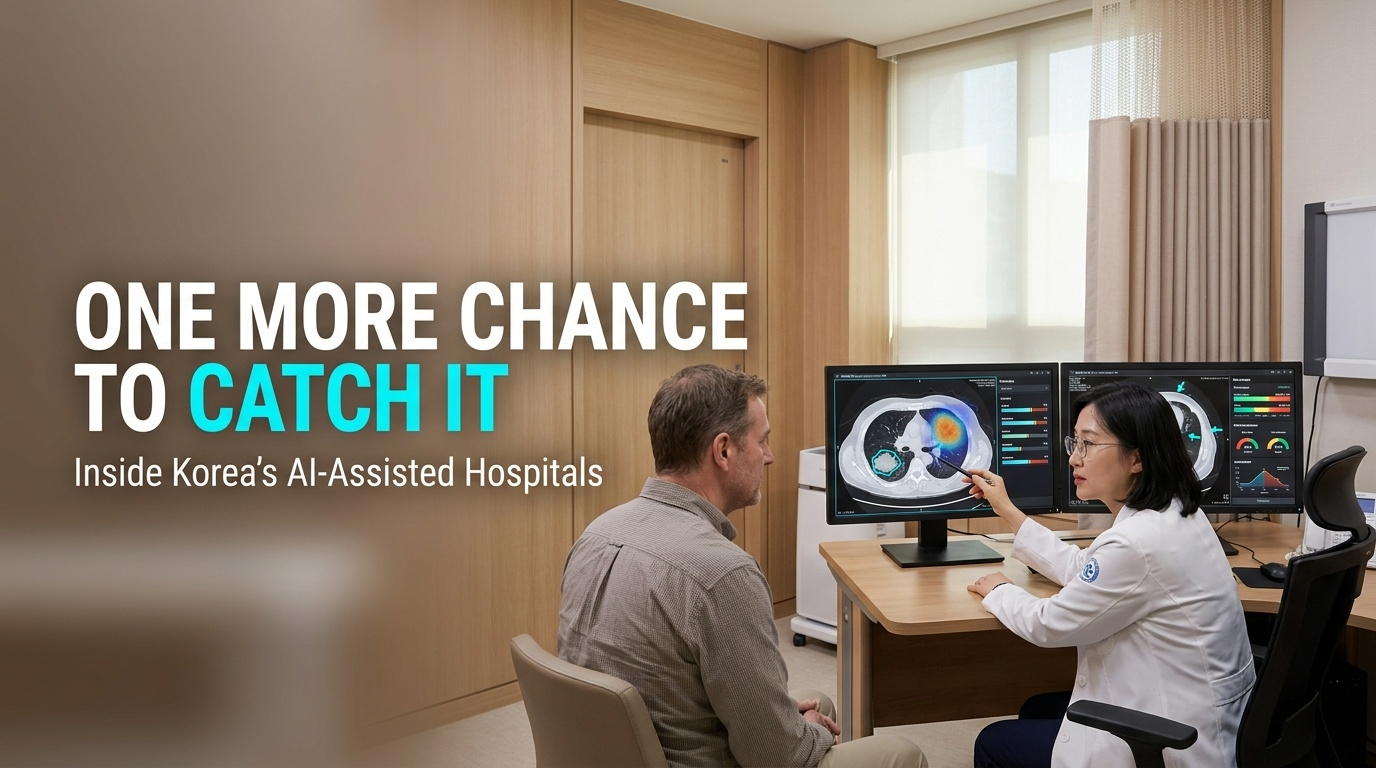
A tiny polyp hidden between folds. A subtle shadow on a mammogram. A hospital patient whose vital signs are beginning to deteriorate.
These are exactly the kinds of details that can be difficult to catch consistently—even for experienced medical professionals working in busy hospitals.
South Korea has a habit of moving promising technology from pilot projects into everyday life quickly. In healthcare, that pattern is becoming increasingly visible as AI moves beyond research papers and into mammography rooms, endoscopy suites, hospital wards, and medical-record systems.
The World Health Organization has pointed to South Korea and Singapore as places where advanced AI has been rapidly adopted. Korean hospitals have also achieved world-first milestones in international assessments of digital imaging and hospital IT infrastructure.
It would be too strong to call Korea the undisputed world leader in medical AI adoption. There is no reliable global league table measuring how extensively every country uses clinical AI. But the evidence supports a more careful conclusion: Korea is one of the world’s fastest-moving and most digitally advanced healthcare markets.
Here, AI is increasingly being used as a second set of eyes. It can highlight a suspicious area, monitor changing patient data, or alert a clinician that something deserves another look.
But does AI in Korean healthcare actually help doctors catch more—and miss less?
Quick Answer
Korean hospital studies suggest that AI can help doctors detect more breast cancers and colon polyps and identify deteriorating hospital patients more accurately than some conventional warning systems.
However, AI does not make the final diagnosis, eliminate medical errors, or replace clinical judgment. Its most realistic role is to provide healthcare professionals with an additional safety layer.
Korea is also one of the faster-moving countries in bringing these systems from research into real hospital workflows, although adoption still varies significantly by hospital and department.
What This Article Covers
- How AI assists breast cancer screening
- How AI helps detect small colon polyps
- How hospitals use AI to identify deteriorating patients
- Why Korea is adopting medical AI so quickly
- Where AI can still make mistakes
- What foreign patients should realistically expect
AI in Korean Healthcare: A Second Set of Eyes
Medical AI is often presented in dramatic terms.
Some headlines suggest that machines will diagnose diseases better than doctors or eventually replace radiologists, pathologists, and other specialists.
That is not how most AI systems are currently being used in Korean hospitals.
In practice, an AI system may analyze an image or stream of clinical data and then:
- Mark a suspicious area on a mammogram
- Place a visual box around a possible colon polyp
- Identify an abnormality on an X-ray or CT scan
- Calculate a patient’s risk of deterioration
- Warn medical staff that a result needs attention
- Help turn a clinician’s spoken notes into a medical record
The doctor still interprets the information, considers the patient’s history, decides whether additional tests are needed, and makes the final clinical decision.
The best way to understand medical AI is not as an electronic doctor. It is an additional observer that can consistently analyze large amounts of information and prompt a healthcare professional to take another look.
That does not mean it is always correct.
It means AI may draw attention to something a clinician should examine more carefully.
1. Breast Cancer Screening: AI Helped Radiologists Detect More Cancers
One of the clearest Korean examples comes from mammography.
A large prospective study included 24,543 women undergoing breast cancer screening at six academic hospitals in South Korea. Researchers compared the performance of breast radiologists reading mammograms with and without AI-assisted computer-aided detection.
With AI assistance, the radiologists detected 140 breast cancers.
Without AI assistance, they detected 123.
That represented a 13.8% increase in the cancer detection rate.
Importantly, the recall rate—the percentage of women called back for additional examination—did not increase significantly.
This matters because a screening system that identifies more cancers but sends many more healthy patients for unnecessary follow-up could create additional anxiety, costs, and medical procedures.
In this study, AI-assisted radiologists found more cancers without a statistically significant increase in recalls.
The researchers also reported increased detection of cancers smaller than 20 millimeters and cancers without lymph-node metastasis.
You can read the full AI-STREAM study in Nature Communications.
What the result means
AI did not independently diagnose 140 patients. Radiologists using AI detected more cancers than the same reading process without AI assistance. The benefit came from combining specialist judgment with an additional detection tool.
For patients, this is a much more realistic reason to be interested in AI than the promise of a fully automated diagnosis.
The technology may help a radiologist pause at a subtle asymmetry or small abnormal area that deserves further investigation.
2. Colonoscopy: AI Helped Doctors Find More Small Polyps
AI is also being used during colonoscopy.
A colon polyp may appear briefly on the monitor as the endoscope moves through the bowel. Some polyps are small, flat, partially hidden behind a fold, or difficult to distinguish from surrounding tissue.
In a prospective randomized study involving 805 patients at six Korean medical institutions, doctors performed colonoscopies either with or without an AI-assisted polyp-detection program.
The results showed:
| Detection measure | Standard colonoscopy | AI-assisted colonoscopy |
|---|---|---|
| Polyp detection rate | 52% | 62% |
| Adenoma detection rate | 28% | 35% |
The AI-assisted group showed a 10-percentage-point increase in polyp detection and a 7-percentage-point increase in adenoma detection.
The difference was especially relevant for polyps measuring 5 millimeters or less, which can be easier to overlook.
The study did not find a significant increase in the total procedure time.
The full results are available in Scientific Reports.
During an AI-assisted colonoscopy, the software analyzes live video and may draw a box or produce an alert when it identifies an area resembling a polyp.
The physician then decides whether the area is truly suspicious and whether it should be examined or removed.
Good to know
A higher detection rate does not mean that every additional finding is cancer. Many colon polyps are not cancerous. However, detecting and appropriately removing certain adenomas is an important part of colorectal cancer prevention.
This is a good example of AI improving precision without taking control of the procedure.
The endoscopist still performs the colonoscopy, controls the equipment, examines each lesion, removes tissue when appropriate, and interprets the clinical findings.
AI simply provides another opportunity to notice something small.
3. Hospital Wards: AI Can Warn Staff Before a Patient Deteriorates
Not all medical AI is designed to analyze images.
Some systems continuously evaluate patient information to identify signs that a person may be getting worse.
A Korean-developed system known as DeepCARS was tested in a prospective study involving 55,083 adult patients at four teaching hospitals in South Korea.
The system used patient data to predict the risk of:
- In-hospital cardiac arrest
- An unexpected transfer to an intensive care unit within 24 hours
Researchers compared DeepCARS with conventional early warning systems known as MEWS and NEWS.
The AI system produced an AUROC score of 0.869, compared with:
- 0.756 for MEWS
- 0.767 for NEWS
AUROC is a statistical measure of how well a model distinguishes between higher-risk and lower-risk cases. A higher value generally indicates stronger discrimination, although it does not mean that the system is correct 86.9% of the time.
At the same level of sensitivity, DeepCARS also generated fewer alarms and a higher proportion of alerts that led to appropriate clinical intervention.
The system identified a larger share of deteriorating patients earlier as well. Fifteen hours before deterioration, DeepCARS had identified 38.7% of affected patients, compared with 25.2% using MEWS and 26.5% using NEWS.
The study can be read in the medical journal Critical Care.
Important
This study showed that the AI system predicted deterioration more accurately and efficiently than the comparison systems. It did not establish that AI alerts independently reduced mortality or prevented every cardiac arrest.
That distinction is essential.
An early warning is useful only if it reaches the correct healthcare professional, is properly understood, and leads to timely assessment and treatment.
AI may recognize the signal.
Doctors, nurses, and rapid-response teams must still determine what it means and what to do next.
Why Korea Is Moving So Quickly
Korea’s medical AI story is not based on a single hospital or one impressive research paper.
The country already has many of the digital foundations needed to introduce new clinical technology relatively quickly: highly connected hospitals, large volumes of structured medical data, experienced medical-device companies, and major university hospitals willing to test new systems.
The World Health Organization has identified South Korea, along with Singapore, as an example of where advanced AI has been rapidly adopted.
Some Korean hospitals have also reached international digital-health milestones.
Samsung Medical Center became the first healthcare provider in the world to achieve the highest Stage 7 rating in the HIMSS Digital Imaging Adoption Model.
It had previously become the first hospital worldwide to reach Stage 7 in the HIMSS Infrastructure Adoption Model.
These achievements do not prove that every Korean hospital is equally advanced.
They do show that parts of Korea’s hospital system have built the digital infrastructure needed to integrate AI into real clinical workflows.
AI is already operating in some Korean hospitals, not only being tested in research projects.
Yeouido St. Mary’s Hospital began operating an AI-based system in January 2025 that analyzes inpatient vital signs and test results to help predict the risk of cardiac arrest.
In February 2026, Seoul St. Mary’s Hospital expanded an AI-powered voice documentation system across its wards. The system converts nurses’ spoken observations into electronic nursing records, reducing repetitive documentation work and helping clinical information enter the medical record more efficiently.
These examples show two very different roles for hospital AI: one supports clinical risk detection, while the other supports medical documentation and workflow.
The transition is now expanding beyond a handful of leading hospitals.
In April 2026, South Korea’s Ministry of Health and Welfare announced an initial KRW 12 billion in support for AI-based clinical systems at regional responsible medical institutions.
The total national budget for the new program is KRW 14.2 billion, with the remaining KRW 2.2 billion scheduled for additional projects later in the year.
The announced projects included:
- Chungbuk National University Hospital and Pusan National University Hospital: Systems analyzing vital signs and test data to predict cardiac arrest, sepsis, and other acute deterioration
- Kyungpook National University Hospital: Real-time monitoring of patient movement and fall risk
- Jeonbuk National University Hospital and Pusan National University Hospital: AI-assisted analysis of chest X-rays and CT images for suspected lung disease and cancer
- Gyeongsang National University Hospital: Imaging analysis for stroke and dementia
- Jeju National University Hospital: Analysis of coronary-artery narrowing using CT data
- Several national university hospitals: Voice-recognition systems that help create medical records
Further details are available in the official announcement from Korea’s Ministry of Health and Welfare.
This does not mean every Korean hospital now offers these systems or that every project has already produced measurable improvements in patient outcomes.
It does show that Korea is investing in AI for real clinical workflows—not only laboratory demonstrations.
Can AI Reduce Medical Errors?
Potentially, but the wording matters.
Medical errors have many possible causes. They may involve:
- A finding that was not noticed
- Incomplete information
- Communication failure
- Incorrect medication
- A delayed response
- A handoff problem
- Inadequate follow-up
- An incorrect clinical assumption
- System or documentation failures
An image-detection algorithm may help with one narrow problem, such as identifying a possible abnormality on a mammogram.
It cannot automatically solve failures involving communication, consent, medication history, language interpretation, hospital staffing, or follow-up after discharge.
For that reason, it is more accurate to say that AI may reduce certain opportunities for human oversight than to claim that it prevents medical mistakes in general.
AI can serve as:
- A second reader
- A real-time visual assistant
- An early warning system
- A prioritization tool
- A documentation assistant
- A prompt to review something again
It is an additional safety layer—not a guarantee.
Where AI Can Also Go Wrong
AI systems can make mistakes of their own.
False Positives
An AI program may highlight normal tissue as suspicious.
This can create unnecessary review, additional testing, patient anxiety, or alert fatigue.
False Negatives
The system may fail to mark a real abnormality.
A doctor who trusts the technology too strongly could be falsely reassured.
Automation Bias
Healthcare professionals may give too much weight to a computer-generated recommendation, particularly when working under time pressure.
AI should support judgment, not replace independent clinical thinking.
Different Patient Populations
A system trained on data from one hospital may perform differently in another hospital, country, age group, or patient population.
Its performance must be validated in the setting where it is used.
Incomplete Clinical Context
AI may see an image or a set of numerical values but not understand the patient’s complete story, personal priorities, symptoms, previous treatment, or social circumstances.
Medicine is not only pattern recognition.
It also requires communication, responsibility, judgment, and human care.
What Foreign Patients Should Expect
Foreign visitors should not assume that every large Korean hospital automatically uses AI or that an “AI hospital” guarantees better treatment.
Hospitals may use AI for only one specific function, such as:
- Mammography
- Chest X-ray interpretation
- Colonoscopy
- Stroke imaging
- Patient deterioration alerts
- Fall monitoring
- Medical documentation
Patients may not even be aware that an AI-assisted system was involved in the workflow.
If you are choosing a hospital for screening or specialist care, more useful questions include:
- Is the hospital experienced in treating this condition?
- Is the relevant specialist qualified and experienced?
- Has the diagnostic system been clinically validated?
- Who reviews the AI result?
- Will a physician explain the final interpretation?
- What happens if the result is uncertain?
- Can the hospital provide medical records in English?
- How will follow-up be managed after you leave Korea?
Technology is valuable, but it is only one part of safe medical care.
Foreign patients also need clear communication, informed consent, transparent prices, usable medical records, and reliable follow-up.
If you are considering diagnostic testing, our guide to why medical tests are often faster in Korea explains how imaging, laboratory work, and specialist visits are commonly organized.
For more complex care, an international clinic in Korea may provide interpretation, appointment coordination, and English medical documents.
If this will be your first ordinary outpatient appointment, see how to visit a clinic in Korea as a foreigner.
Frequently Asked Questions
Is AI currently used in Korean hospitals?
Yes. Some Korean hospitals use AI-assisted tools for medical imaging, colonoscopy, deterioration prediction, documentation, and patient monitoring.
Availability varies by hospital, department, and clinical purpose. The use of one AI system does not mean that AI is involved in every part of a patient’s care.
Does AI make Korean hospitals safer?
AI may improve certain safety functions, such as detecting suspicious lesions or identifying patients at risk of deterioration.
However, safety still depends on staff response, clinical judgment, communication, follow-up, and the hospital’s overall systems. AI is an additional tool rather than a guarantee of safety.
Can I request an AI-assisted medical test in Korea?
You can ask whether a hospital uses AI assistance for a particular examination, but it may not be offered as a separate patient-selectable service.
Hospitals usually decide which approved tools are included in their clinical workflows. A physician should still review and explain the final result.
Korea Compass Note
The most promising medical AI is often not the technology that tries to appear most human.
It is the technology that quietly helps a human professional notice one more important detail.
In a Korean hospital, that may mean a faint shadow on a mammogram, a tiny polyp during colonoscopy, or a change in vital signs hours before a patient becomes critically ill.
AI does not remove uncertainty from medicine.
But when it is properly validated, carefully supervised, and responsibly used, it may provide doctors and nurses with another opportunity to look again—and act sooner.
Final Thoughts
Real Korean hospital studies show that AI assistance can improve particular parts of medical care.
Radiologists using AI detected more breast cancers without a significant increase in recalls.
Endoscopists using AI found more polyps and adenomas, especially small lesions.
An AI early warning system identified deteriorating hospital patients more accurately and with fewer unnecessary alerts than conventional comparison systems.
Korea’s digital hospital infrastructure and public investment also make it one of the countries moving quickly to bring medical AI into real clinical settings.
These findings are encouraging, but they do not mean medical errors have been eliminated.
The safest future is not AI replacing Korean doctors.
It is skilled healthcare professionals using well-tested AI as a second set of eyes—while remaining responsible for the final decision.