
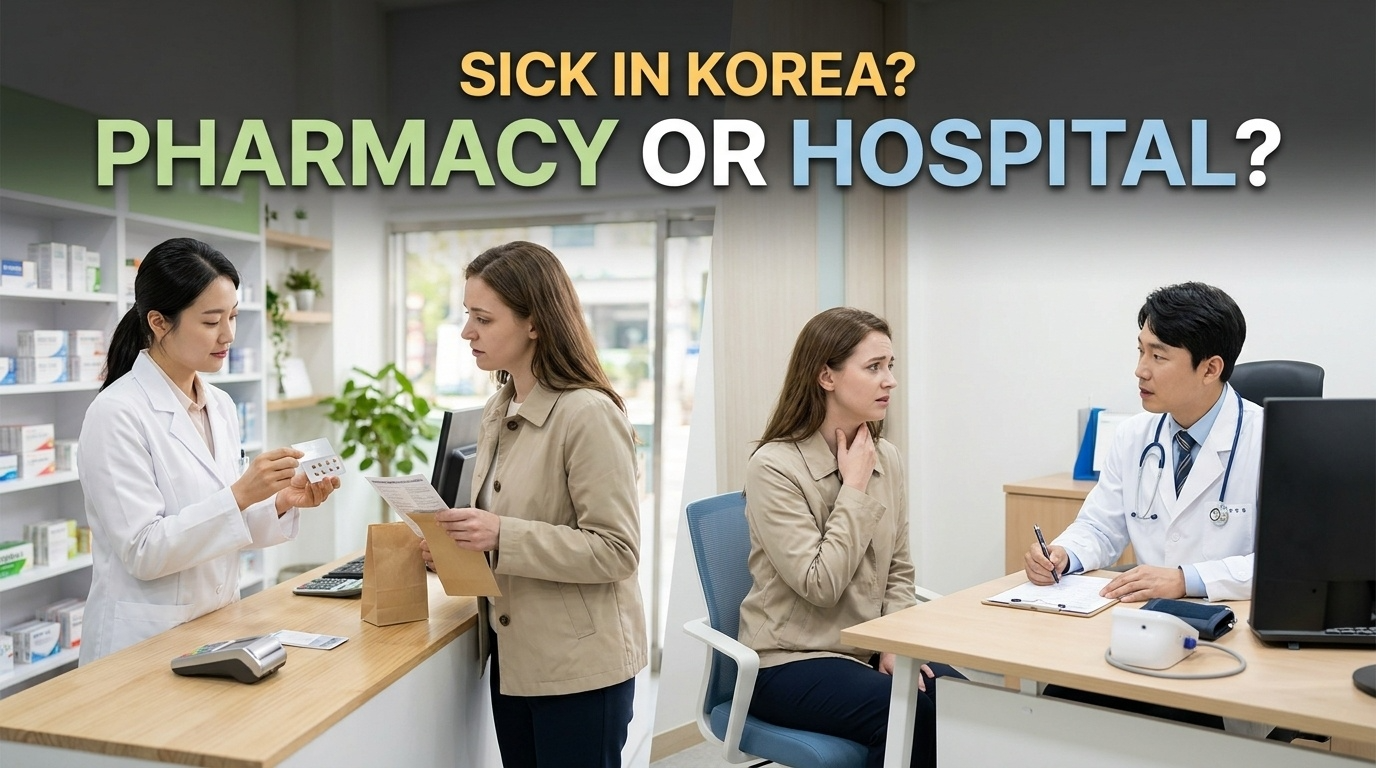
You wake up in Korea with a sore throat and a fever.
Your regular medication has run out, but the prescription was issued in another country.
Or your child becomes sick on a Sunday, when most neighborhood clinics appear to be closed.
Should you visit a Korean pharmacy or hospital? Do you need a prescription? Can a pharmacist recommend something, or do you need to see a doctor first?
For foreigners, the confusing part is not always finding medical care. It is understanding which type of medical facility is appropriate.
A pharmacy can help you obtain and understand medicine, but it does not replace a doctor’s examination. For most non-emergency health problems, a neighborhood clinic is usually the practical first stop. For a serious emergency, call 119.
Here are seven things foreigners should know before choosing a Korean pharmacy or hospital.
1. A Korean Pharmacy or Hospital Is Not the Only Choice
In Korea, medical care is not divided into only pharmacies and large hospitals. There are several different levels of care.
Pharmacy: 약국
A pharmacy is where you purchase prescription medicine and ask about non-prescription products for relatively minor problems.
Pharmacists can explain how to take medicine, check for possible duplication and help you identify available over-the-counter products. However, a pharmacy is not a substitute for a medical examination.
Clinic: 의원
A neighborhood clinic is usually the most practical starting point for a non-emergency illness or injury.
Clinics normally focus on a particular specialty, such as internal medicine, pediatrics, dermatology or orthopedics. They are generally smaller and easier to access than university hospitals.
Hospital: 병원 or 종합병원
Hospitals provide a broader range of tests, specialist care, procedures and inpatient treatment. Depending on the hospital and department, you may need an appointment or referral.
If you are considering advanced imaging, read our guide to getting an MRI in Korea as a foreigner.
Emergency room: 응급실
An emergency room is for potentially serious or time-sensitive conditions. It should not be treated simply as a late-night substitute for a regular clinic.
The first decision, therefore, is not just “Korean pharmacy or hospital?” It may be pharmacy, neighborhood clinic, hospital outpatient department or emergency room.
2. A Pharmacy Can Help With Minor Problems—Within Limits
A Korean pharmacy may be a reasonable first stop when you need advice about a mild, familiar problem or want to ask whether a non-prescription product is available.
Examples may include:
- A mild cold or sore throat
- Minor digestive discomfort
- A small cut or scrape
- A simple insect bite
- Basic pain or fever relief
- Questions about how to take medicine you have already received
Describe the symptom clearly and tell the pharmacist about allergies, pregnancy, chronic conditions and other medicines you are taking.
A translation app can help, but it is better to show the pharmacist the exact active ingredient or a clear photo of the original package than to rely only on a foreign brand name. The same medicine may be sold under a different brand in Korea.
The Korea Tourism Organization also recommends using photos or translation tools when communicating at a pharmacy. Complicated conditions, however, may require a clinic visit and medical records rather than pharmacy advice. See the official VisitKorea pharmacy guide for additional visitor information.
For a closer look at commonly available medicines, see Medicine in Korea Without a Prescription.
Do not pressure a pharmacist to sell a specific drug if they advise you to see a doctor. That recommendation may mean the medicine requires a prescription or that your symptoms need proper evaluation.
3. Prescription Medicine Usually Starts With a Doctor
Under Korea’s Pharmaceutical Affairs Act, pharmacists generally dispense prescription drugs according to prescriptions issued by doctors or dentists, apart from limited legal exceptions.
This means an overseas prescription, a medication bottle or a photo of your usual medicine can be helpful—but you should not assume that a Korean pharmacy can automatically dispense it.
A local doctor may need to:
- Review your medical history.
- Confirm the condition being treated.
- Check whether the same drug or an equivalent is available in Korea.
- Issue a Korean prescription when appropriate.
If you take regular medication, bring as much of the following information as possible:
- The generic or active ingredient name
- The dosage and frequency
- A photo of the original package
- Your overseas prescription
- A brief medical summary
- Information about allergies and previous reactions
- A list of other medicines and supplements you take
The active ingredient is especially important. Brand names vary between countries, while the generic name makes it easier for a Korean medical professional to understand what you have been taking.
The relevant dispensing rule can be found in the English version of Korea’s Pharmaceutical Affairs Act.
4. For Most Non-Emergencies, Start With the Right Clinic
Many foreigners assume that a major university hospital must be the safest place for any medical problem. In reality, a local specialist clinic is often faster, less complicated and more appropriate for an initial evaluation.
Look for these common clinic signs:
| Korean sign | Department | Common reasons to visit |
|---|---|---|
| 내과 | Internal medicine | Fever, cough, stomach problems, general adult illness |
| 이비인후과 | ENT | Sore throat, ear pain, sinus or nasal symptoms |
| 소아청소년과 | Pediatrics | Illness in babies, children and teenagers |
| 피부과 | Dermatology | Rashes, skin irritation and other skin conditions |
| 정형외과 | Orthopedics | Joint, muscle or minor injury concerns |
| 안과 | Ophthalmology | Eye pain, irritation or vision concerns |
| 산부인과 | Obstetrics and gynecology | Pregnancy and women’s health concerns |
This list is only a general guide. Symptoms can overlap, and medical staff may direct you to a different department.
A typical clinic visit may involve registration, a short wait, an examination and a prescription. You then take the prescription to a nearby pharmacy, pay separately and receive the medicine with dosage instructions.
If your child becomes ill, our guide on what to do when a child gets sick in Korea explains the process in more detail.
5. Nights, Sundays and Language Barriers Change the Plan
Choosing a Korean pharmacy or hospital becomes more difficult after normal business hours.
Some pharmacies and clinics open in the evening or on Sundays, but operating hours vary. A listing marked “open” on a map may not reflect a temporary closure, holiday schedule or registration cutoff.
Useful Korean searches include:
약국— pharmacy영업중 약국— pharmacy currently open일요일 약국— Sunday pharmacy야간진료— night medical service일요일 진료— Sunday medical service응급실— emergency room
Use Naver Map or KakaoMap to search near your location, and call before traveling when possible. Our Naver Map and KakaoMap guide explains how foreigners can use both services.
The Korean Pharmaceutical Association’s Pharm114 service can also help locate holiday or duty pharmacies. Because schedules can change, confirm the hours directly whenever possible.
The 1330 Korea Travel Hotline offers multilingual travel assistance, but it is not a replacement for emergency medical services. In a medical emergency, call 119.
Medical interpretation in Seoul
In 2026, the Seoul Metropolitan Government is operating the MeSic medical interpretation accompaniment program for eligible foreign residents, workers and international students in Seoul.
The program provides professional medical interpretation in multiple languages and generally requires advance application. Eligibility, language availability, usage limits and remaining budget should be confirmed before relying on it.
Details are available from the Seoul Foreign Resident Center.
6. Insurance Coverage Does Not Always Mean Direct Billing
Having international insurance does not necessarily mean a Korean clinic or hospital will bill your insurer directly.
Three separate questions are involved:
- Does your insurance policy cover treatment in South Korea?
- Does the medical provider have a direct-billing arrangement with your insurer?
- Has the insurer authorized payment for this particular visit or treatment?
If the answer to the second or third question is no, you may have to pay first and submit a claim later.
Bring:
- Your passport or Alien Registration Card
- Your insurance card or policy information
- A payment card
- A list of your current medicines
- Relevant medical records
- Your insurer’s assistance telephone number
Before leaving the clinic or hospital, ask for an itemized bill, receipt, prescription and any medical certificate required by your insurer.
For a complete explanation, read International Health Insurance in Korea: Why You May Still Pay Upfront.
Pharmacy purchases may also be treated differently from doctor-prescribed medication under your policy. Check whether over-the-counter products, prescriptions and consultation fees are reimbursable.
7. Know When to Skip the Pharmacy and Call 119
Do not spend time searching for an open pharmacy when symptoms may indicate a serious emergency.
Call 119 or seek emergency medical assistance for situations such as:
- Severe difficulty breathing
- Loss of consciousness
- Signs of a stroke, including sudden facial weakness or speech difficulty
- Severe chest pain
- Uncontrolled bleeding
- A serious allergic reaction
- A major traffic accident or traumatic injury
- A seizure that does not stop
- Any condition that appears immediately life-threatening
This is not a complete diagnostic list. If you are unsure whether a situation is dangerous, contacting emergency services is safer than relying on an online article.
Korea uses:
119for fire, rescue and medical emergencies112for police emergencies1330for multilingual travel information and non-emergency visitor assistance
The Korea Tourism Organization provides additional details in its official emergency information guide.
For major injuries, you may also want to understand how Korea’s trauma centers work.
Useful Questions to Ask
These questions can help at a clinic or pharmacy:
- Do I need to see a doctor for this?
- Is this medicine available without a prescription?
- Does this medicine contain the same active ingredient?
- How often should I take it?
- Should I take it before or after meals?
- Could it interact with my other medicine?
- Is there an English-speaking doctor or interpreter?
- Can you provide an itemized receipt for insurance?
- Is there a clinic open nearby?
Do not be embarrassed to ask the pharmacist to repeat the dosage instructions. Before leaving, confirm how many pills to take, how often to take them and for how many days.
Useful Korean Phrases
약국이 어디예요?
Yakgugi eodiyeyo?
Where is a pharmacy?이 약은 처방전이 필요한가요?
I yageun cheobangjeoni piryohangayo?
Does this medicine require a prescription?이 약과 같은 성분이 있나요?
I yakgwa gateun seongbuni innayo?
Do you have medicine with the same active ingredient?하루에 몇 번 먹어요?
Harue myeot beon meogeoyo?
How many times a day should I take it?영어 가능한 의사 선생님이 있나요?
Yeongeo ganeunghan uisa seonsaengnimi innayo?
Is there an English-speaking doctor?오늘 진료 가능한가요?
Oneul jinryo ganeunghangayo?
Can I receive treatment today?응급실이 어디예요?
Eunggeupsiri eodiyeyo?
Where is the emergency room?
More everyday expressions are available in our guide to basic Korean phrases for travelers.
Source Note
This guide uses Korea’s Pharmaceutical Affairs Act for the general rule governing prescription dispensing.
Practical pharmacy and emergency information was checked against Korea Tourism Organization guidance. Information about Seoul’s MeSic interpretation service comes from the Seoul Metropolitan Government’s 2026 program announcement.
Opening hours, program availability, insurance rules and medical procedures can change. Confirm time-sensitive information directly with the pharmacy, clinic, hospital, insurer or responsible government service.
Korea Compass Note
The most common mistake is often not choosing a pharmacy instead of a hospital. It is going directly to a large hospital when a nearby specialist clinic could handle the initial evaluation more efficiently.
For a minor but unfamiliar problem, find the appropriate clinic first. If the doctor prescribes medicine, take the prescription to the pharmacy. If the condition appears dangerous, skip both steps and call 119.
That simple distinction can save time and reduce confusion.
Bottom Line
When deciding between a Korean pharmacy or hospital, think about the purpose of the visit.
Use a pharmacy for medicine dispensing, dosage questions and limited assistance with minor problems. Visit a neighborhood clinic when you need an examination, diagnosis or prescription. Use a hospital when specialist testing or more advanced treatment is required.
For a potentially serious emergency, call 119.
Have you visited a clinic or pharmacy in Korea? What part of the process was most confusing? Share your experience in the comments—it may help another foreign resident or traveler.
This article provides general information and is not a substitute for professional medical advice, diagnosis or emergency care.
I used to think a big hospital was always the safest choice, but for most everyday problems in Korea, a neighborhood clinic is usually much easier. Have you ever had trouble deciding where to go?