
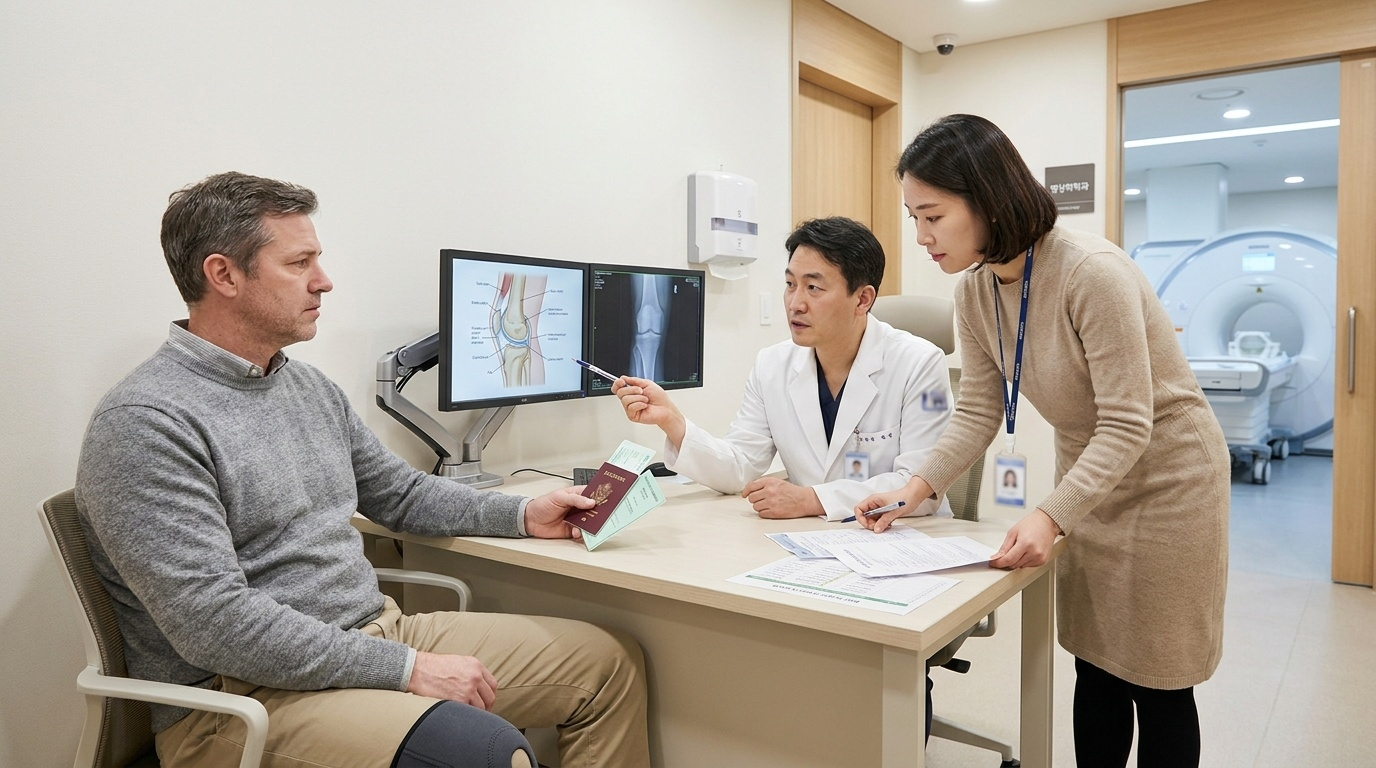
You hurt your knee during a trip.
A headache has continued for weeks.
Or a doctor back home told you to arrange follow-up imaging while you are in South Korea.
Now you need an MRI in Korea for foreigners, but the practical questions begin immediately:
Can you book the scan directly?
Do you need a referral?
How much will it cost without Korean health insurance?
Will your international insurance pay?
The most important point is this:
An MRI in Korea is usually part of a medical evaluation—not a retail service that you simply select from a menu.
A doctor normally decides which body part should be scanned, whether contrast is needed, how urgent the examination is and whether MRI is actually the most appropriate test.
Here are the seven things international patients should understand.
1. MRI in Korea for Foreigners Usually Starts With a Doctor
Most hospitals will not expect a patient to walk directly into the radiology department and request “an MRI.”
The examination normally begins with a consultation in a department related to the symptoms.
Examples include:
- Orthopedics for knee, shoulder, hip or ankle problems
- Neurosurgery or neurology for certain brain, spine or nerve symptoms
- Internal medicine for some abdominal or systemic conditions
- Breast surgery or gynecology for specific breast or pelvic concerns
- Family medicine when the correct specialty is unclear
The physician reviews your symptoms, physical examination and previous records before ordering the appropriate imaging protocol.
This matters because “MRI” is not one standardized test.
A brain MRI is different from a brain MRA.
A lumbar-spine MRI is different from a hip MRI.
A study performed with contrast may answer a different question from a non-contrast examination.
If this is your first Korean medical visit, read How to Visit a Clinic in Korea as a Foreigner before booking.
2. Do You Need a Referral?
The answer depends on what you mean by “referral.”
A medical order for the MRI
A Korean doctor will generally evaluate you and order the scan as part of your care.
An old foreign prescription, overseas MRI request or email from your home-country doctor can be valuable background information, but the Korean physician remains responsible for deciding which examination is appropriate locally.
Bring:
- Your doctor’s referral or imaging request
- Previous MRI, CT or X-ray reports
- The actual imaging files, if available
- A brief medical history
- Current medicines
- Information about prior surgery or implants
A referral letter for a tertiary hospital
This is a separate issue.
Large tertiary hospitals may require a referral letter for Korean National Health Insurance benefits to apply.
Seoul National University Hospital’s outpatient guide states that patients using Korean National Health Insurance generally need a referral letter before visiting the tertiary hospital, except for family medicine.
Samsung Medical Center provides similar guidance for first visits under Korean National Health Insurance.
A foreign tourist who is paying privately may still request an international-patient appointment without Korean insurance.
However, the hospital may first schedule a physician consultation rather than allowing direct MRI booking.
3. How Much Does an MRI Cost in Korea?
There is no single nationwide cash price for an MRI.
The cost depends on:
- Body part
- One area or several areas
- Standard or specialized protocol
- Use of contrast
- Hospital type
- Medical necessity
- Korean National Health Insurance eligibility
- Whether the examination meets insurance coverage criteria
- Additional consultation, laboratory or sedation charges
Korea’s Health Insurance Review and Assessment Service explains that MRI may be covered in some circumstances and treated as non-covered care in others.
When the examination is non-covered, each medical institution establishes its own price and the patient normally pays the full amount.
The same hospital may also charge different prices according to the body part, examination time or protocol.
A real 2026 tertiary-hospital example
The 2026 non-covered fee schedule published by Asan Medical Center lists several standard joint MRI examples at approximately:
- KRW 626,000 to KRW 1,001,000 for some shoulder or knee examinations
- KRW 678,000 to KRW 1,095,000 for some elbow or ankle examinations
- Around KRW 1,147,000 or more for several contrast-enhanced joint studies
These figures are examples from one major tertiary hospital.
They are not a national average or a guaranteed quote.
The final bill may also include:
- Doctor consultation
- Contrast material
- Blood testing
- Sedation
- Additional sequences
- Medical certificates
- Imaging copies
Before committing to the scan, ask the hospital:
“What is the estimated total self-pay cost, including consultation, MRI interpretation, contrast and any required laboratory tests?”
4. Can You Use Foreign or Travel Insurance?
Possibly—but insurance coverage and direct billing are not the same thing.
Some international insurers have direct-billing agreements with selected Korean hospitals.
The insurer may send the hospital a Guarantee of Payment, often called a GOP.
Without an approved GOP, you may have to pay the hospital first and request reimbursement later.
Samsung Medical Center’s international billing guide states that self-paying international outpatients generally pay for examinations and treatment before receiving the service.
It also explains that patients without a GOP must pay upfront and claim reimbursement independently.
Before the appointment, ask your insurer:
- Is outpatient MRI covered?
- Is prior authorization required?
- Must a doctor document medical necessity?
- Is this hospital recognized by the plan?
- Can the insurer issue a GOP?
- Is contrast covered?
- Are consultation and radiology interpretation covered?
- What documents are required for reimbursement?
Do not assume that an American insurance card automatically creates cashless service in Korea.
Foreign visitors concerned about self-payment and insurance reimbursement should also read Can You See a Doctor in Korea Without Insurance? Yes — Here’s What Happens.
5. MRI and CT Are Not the Same Test
MRI uses a strong magnetic field and radiofrequency energy to create images.
It does not use the ionizing X-ray radiation used by CT.
MRI is particularly useful for many examinations involving:
- Brain and spinal cord
- Nerves
- Muscles
- Ligaments and tendons
- Joints
- Bone marrow
- Certain tumors and soft tissues
CT is often faster and may be preferred in situations such as acute trauma, suspected internal bleeding, lung evaluation or some bone injuries.
One test is not universally “better” than the other.
The right examination depends on the clinical question.
Asan Medical Center’s MRI guide explains that MRI provides strong soft-tissue contrast and may be particularly useful for neurological, muscular and other soft-tissue conditions.
That is another reason the decision should begin with a doctor rather than with the patient choosing a scanner independently.
6. Tell the Hospital About Metal, Implants and Pregnancy
MRI safety screening is not a formality.
The scanner contains a powerful magnet.
Before the examination, tell the medical team about:
- Pacemaker or defibrillator
- Aneurysm clip
- Cochlear implant
- Neurostimulator
- Medication pump
- Metal fragments or shrapnel
- Previous metal work near the eyes
- Joint replacement
- Surgical clips or coils
- Pregnancy or possible pregnancy
- Kidney disease
- Previous reaction to MRI contrast
- Severe claustrophobia
Having an implant does not automatically mean MRI is impossible.
Many modern devices are MRI-conditional and may be scanned under specific conditions.
However, the radiology team needs the exact device information.
Bring the implant card, manufacturer, model number and date of surgery whenever possible.
The current MRI safety guidance from RadiologyInfo, produced by the American College of Radiology and Radiological Society of North America, emphasizes that implants and internal metal must be identified before the patient enters the MRI environment.
What about contrast?
Some MRI examinations use a gadolinium-based contrast agent.
The hospital may check kidney function first, particularly when there is a history of kidney disease or another relevant medical concern.
Pregnant patients should disclose the pregnancy before the scan. Gadolinium contrast is generally avoided during pregnancy unless the clinical benefit justifies its use.
What about claustrophobia?
Tell the hospital before the appointment.
Possible approaches may include:
- Additional explanation and preparation
- A less confining scanner, when available
- Music or communication during the scan
- Mild sedation prescribed by a physician
Sedation may require fasting, an accompanying adult and restrictions on driving afterward.
Do not arrive and disclose severe claustrophobia only after the scanner is ready.
7. Ask for the Report and Images Before You Leave Korea
The MRI examination is only one part of the process.
A radiologist interprets the study and produces a report.
The doctor who ordered the test then explains how the result relates to your symptoms and treatment.
Before leaving the hospital—or Korea—ask for:
- English radiology report, if available
- Imaging files on CD or another permitted format
- Itemized bill
- Official receipt
- Doctor’s note or medical certificate, if required
- Copy of the MRI order
- Laboratory results related to contrast
- Follow-up recommendations
Seoul National University Hospital lists radiological results, including MRI, among the records that patients may request through its medical-record process.
Samsung Medical Center also states that its imaging studies can be provided on CD through the official documentation process.
Do not wait until you return home to discover that your insurer or doctor needs the actual images rather than only a one-page report.
How Long Will the MRI Take?
The examination time varies according to the body part and protocol.
Some scans are relatively short, while specialized, contrast-enhanced or multi-region examinations may take considerably longer.
During the scan, you may hear loud knocking or mechanical sounds.
You must remain as still as possible because movement can reduce image quality and sometimes require repeat sequences.
Follow the hospital’s preparation instructions rather than assuming that every MRI requires the same fasting period.
Some contrast-enhanced or sedated examinations may require several hours of fasting.
Other non-contrast studies may not.
Can You Book an MRI Quickly in Korea?
Korea has extensive diagnostic-imaging capacity, but a rapid appointment is not guaranteed.
Availability depends on:
- Medical urgency
- Hospital size
- Scanner schedule
- Body part
- Need for contrast
- Specialist availability
- Insurance authorization
- Need to review implants or previous records
A local orthopedic or neurology clinic may sometimes arrange imaging more simply than a famous tertiary hospital.
A tertiary center may be more appropriate when:
- The condition is complex
- Surgery may be required
- A rare diagnosis is suspected
- Several specialties must coordinate
- Previous imaging is unclear
- Your insurer specifically directs you there
The fastest appointment is not automatically the best pathway.
For more context on accessing specialists, read 31 Days for a Doctor in America? In Korea, You Can Often Go Straight to a Specialist.
Useful Questions to Ask Before Booking
Send these questions to the hospital or international center:
- Do I need a consultation before the MRI?
- Which department should evaluate my symptoms?
- Can you review my foreign referral and previous images?
- Is contrast expected?
- Do I need a kidney-function blood test?
- What is the estimated total self-pay cost?
- Is payment required before the examination?
- Can you work with my international insurer?
- What documents are available in English?
- Can I receive the report and imaging files before leaving Korea?
Useful Korean Phrases
I need an MRI examination.
MRI 검사가 필요합니다.
MRI geomsaga piryohamnida.
Do I need to see a doctor first?
먼저 의사 진료를 받아야 하나요?
Meonjeo uisa jillyoreul badaya hanayo?
How much is the total self-pay cost?
비보험으로 총비용이 얼마인가요?
Biboheomeuro chongbiyongi eolmaingayo?
Will contrast be used?
조영제를 사용하나요?
Joyeongjereul sayonghanayo?
I have a metal implant.
몸 안에 금속 임플란트가 있습니다.
Mom ane geumsok impeullanteuga itseumnida.
I need the MRI images and English report.
MRI 영상과 영문 판독지가 필요합니다.
MRI yeongsanggwa yeongmun pandokjiga piryohamnida.
The Bottom Line
Getting an MRI in Korea for foreigners is entirely possible.
But the correct process normally begins with a medical consultation.
The doctor determines the body part, imaging protocol, need for contrast and clinical urgency.
The price can vary substantially according to the hospital, coverage status and type of study.
Foreign insurance may reimburse the examination, but direct billing normally requires advance confirmation and often a Guarantee of Payment.
Before booking:
- Bring your medical records
- Confirm the full estimated price
- Disclose all implants and medical conditions
- Contact your insurer
- Request the report, images and itemized bill
The goal is not simply to obtain an MRI quickly.
It is to obtain the correct MRI, interpreted by the right medical team, with no unexpected safety or payment problems.