
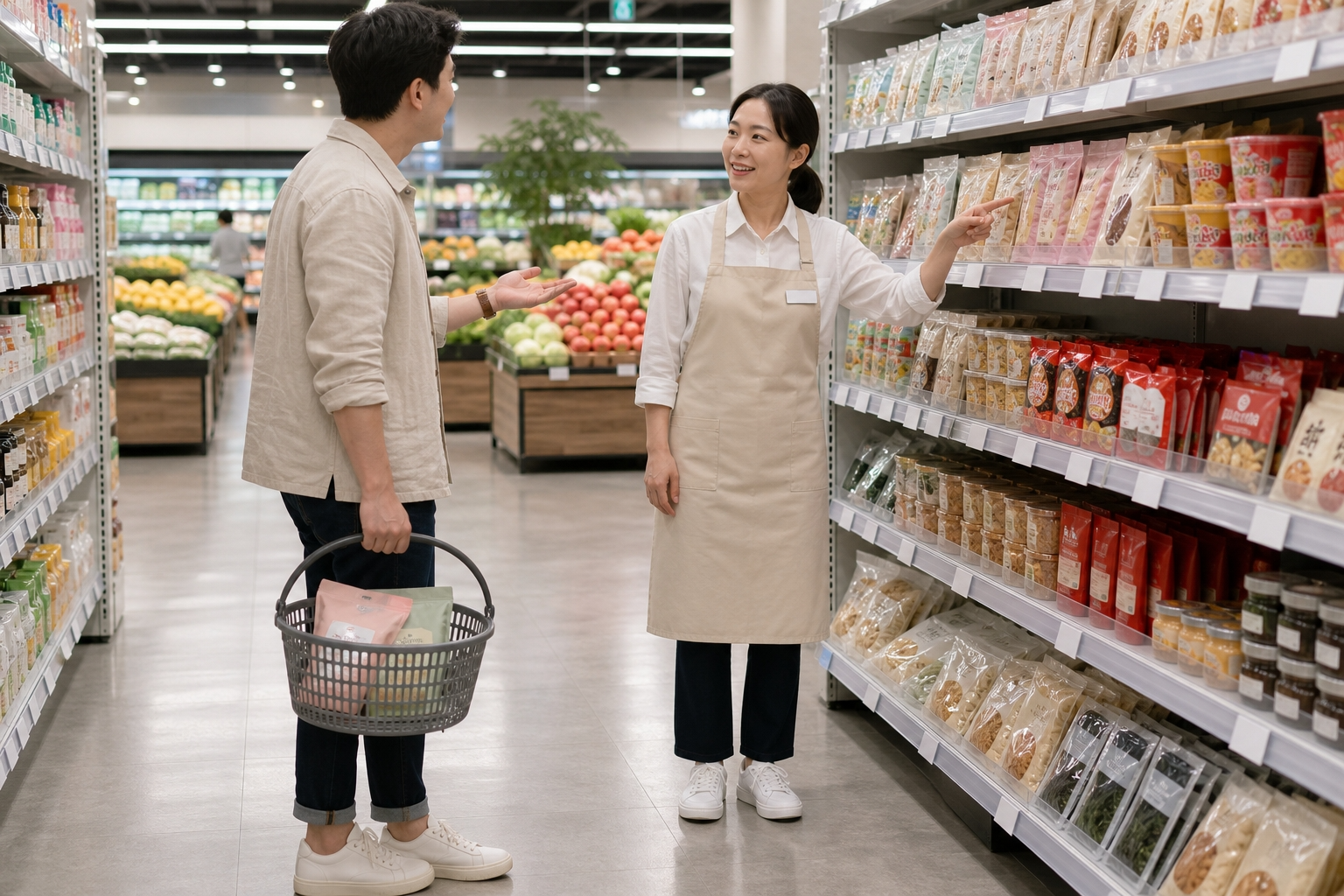
This Korean supermarket guide explains how foreign visitors can shop for groceries, snacks, drinks, prepared food, and souvenirs in Korea.
Large Korean supermarkets can be interesting places to visit because they show what local families actually buy and eat.
You can find fresh produce, instant noodles, sauces, frozen food, bakery products, household goods, cosmetics, and large snack sections in one place.
The shopping process is familiar, but there are a few differences involving shopping carts, produce labels, bags, payment, and food packaging.
Korean Supermarket Guide: What to Expect
Korean supermarkets range from small neighborhood grocery stores to large multi-floor hypermarkets.
A large store may include:
- Fresh produce
- Meat and seafood
- Prepared meals
- Bakery items
- Snacks and drinks
- Instant noodles
- Frozen foods
- Household products
- Cosmetics
- Clothing
- Electronics
- Restaurants or food courts
Some supermarkets are inside shopping malls or department store basements.
Others are standalone stores in residential areas.
Shopping Carts and Baskets
Hand baskets are usually available near the entrance.
Large carts may require a coin deposit or special unlocking system.
In some stores, insert a 100-won or 500-won coin to release the cart. The coin is returned when you reconnect the cart after shopping.
Not every store uses this system.
If you do not have a coin, use a hand basket or ask an employee for help.
Produce and Price Labels
Fruit and vegetables may be sold:
- Per item
- Per package
- By weight
- In fixed-size trays
- In large gift boxes
Korean fruit can be expensive, especially premium strawberries, grapes, melons, pears, and gift sets.
Check whether the displayed price applies to one piece or the entire package.
Useful words include:
- 개 — item or piece
- 팩 — pack
- 봉 — bag
- 묶음 — bundle
- 100g — price per 100 grams
- 국내산 — produced in Korea
- 수입산 — imported
Some produce must be weighed and labeled before checkout.
Look for a scale nearby or watch what other customers do.
Meat and Seafood Sections
Korean supermarkets usually offer a wide range of sliced meat for barbecue, soup, stir-frying, and hot pot.
Packages may be labeled by use.
Common words include:
- 구이용 — for grilling
- 불고기용 — for bulgogi
- 국거리 — for soup
- 찌개용 — for stew
- 삼겹살 — pork belly
- 소고기 — beef
- 돼지고기 — pork
- 닭고기 — chicken
Seafood sections may sell fresh, frozen, dried, or prepared products.
Some stores offer cooking or cleaning services, but communication may be difficult without Korean.
For a short trip, prepackaged portions are usually easier.
Prepared Food
The prepared-food section is one of the most useful parts of a Korean supermarket.
You may find:
- Kimbap
- Fried chicken
- Dumplings
- Sushi
- Salads
- Lunch boxes
- Jeon
- Side dishes
- Roasted sweet potatoes
- Bread
- Ready-to-heat meals
Discount stickers may appear later in the evening.
Check the use-by date and storage instructions before buying.
Some prepared food must be refrigerated and eaten quickly.
Instant Noodles
Korean supermarkets have large instant-noodle sections.
Products may come in cups, bowls, packets, or multipacks.
Check whether the product is:
- Spicy
- Very spicy
- Soup-based
- Stir-fried
- Seafood-flavored
- Cheese-flavored
- Black-bean flavored
The word “매운맛” means spicy flavor.
“순한맛” means mild flavor.
However, Korean “mild” products may still feel spicy to some visitors.
Do not buy a large multipack until you know you like the flavor.
Snacks and Souvenirs
Supermarkets are good places to buy affordable food souvenirs.
Popular categories include:
- Seaweed snacks
- Chocolate pies
- Rice crackers
- Honey-flavored snacks
- Almond snacks
- Instant coffee
- Tea
- Candy
- Cookies
- Instant noodles
- Korean sauces
- Seasoning mixes
Choose sealed products with clear expiration dates.
Avoid buying refrigerated products unless you can keep them cold.
Check your destination country’s customs rules before packing meat, fruit, seeds, or fresh food.
Korean Sauces and Cooking Ingredients
Useful Korean pantry products include:
- Gochujang
- Doenjang
- Ssamjang
- Sesame oil
- Soy sauce
- Kimchi seasoning
- Bulgogi sauce
- Seaweed
- Soup stock packets
Sauce containers can leak in luggage.
Place them in a sealed plastic bag and pack them carefully.
Large glass containers may be heavy, so smaller plastic packages are easier for travelers.
Milk, Yogurt, and Drinks
Dairy sections may include flavored milk, yogurt drinks, coffee, juice, and traditional beverages.
Check the date carefully because some products have short shelf lives.
Common drinks include:
- Banana-flavored milk
- Coffee milk
- Yogurt drinks
- Sikhye
- Barley tea
- Corn tea
- Fruit juice
- Bottled coffee
Some bottles look similar even when the flavors are different.
Use a translation app or image search when you are unsure.
Bakery Sections
Many large supermarkets have an in-store bakery.
You may find bread, cakes, croissants, donuts, sandwiches, and Korean-style sweet breads.
Some items are self-service.
Use the provided tray and tongs rather than touching bread with your hands.
For more information, read Korean Bakery Guide for Foreigners: What to Try in Korea.
Payment
Cards are widely accepted in Korean supermarkets.
International cards often work, but acceptance is never guaranteed.
Carry a backup payment method.
At checkout, the cashier may ask:
- Whether you need a bag
- Whether you have a membership card
- Whether you need a receipt
- Whether you want installment payment
For a normal foreign card purchase, pay the full amount in one transaction.
If asked about a membership card, say:
“없어요.”
Eopseoyo.
I do not have one.
Shopping Bags
Disposable shopping bags may cost extra or may not be available.
Some stores offer reusable bags, paper bags, or cardboard boxes.
Bring a foldable shopping bag when possible.
Near the exit, you may find a packing table and empty cardboard boxes.
Do not take a store basket or cart outside the permitted area.
Self-Checkout
Some supermarkets have self-checkout machines.
English support may be available, but not always.
The usual process is:
- Scan each product.
- Place it in the bagging area.
- Select a bag if needed.
- Choose card payment.
- Insert or tap the card.
- Take the receipt.
Alcohol purchases may require staff verification.
If the machine stops, wait for an employee rather than repeatedly scanning the product.
Delivery and Tax Refunds
Large supermarkets may offer local delivery services, but these are usually designed for residents with Korean addresses and phone numbers.
Do not assume same-day delivery will be easy for tourists.
Some locations may provide tax refunds for eligible foreign visitors.
Tax-refund availability depends on the store, purchase amount, and product category.
Bring your passport if you plan to request a refund.
Check the signs at the customer-service desk.
Useful Korean Phrases
“이거 얼마예요?”
Igeo eolmayeyo?
How much is this?
“이거 어디 있어요?”
Igeo eodi isseoyo?
Where is this?
“봉투 주세요.”
Bongtu juseyo.
Please give me a bag.
“봉투 필요 없어요.”
Bongtu piryo eopseoyo.
I do not need a bag.
“카드 돼요?”
Kadeu dwaeyo?
Can I pay by card?
“매워요?”
Maewoyo?
Is it spicy?
“유통기한이 언제예요?”
Yutonggihani eonjeyeyo?
When does it expire?
Common Mistakes Foreign Visitors Make
The first mistake is assuming the displayed price is for one item when it is for a full package.
The second is buying too many refrigerated products without a refrigerator.
The third is purchasing a large multipack before trying the flavor.
The fourth is forgetting to bring a shopping bag.
The fifth is packing sauces without sealing them.
The sixth is buying fresh food that cannot be taken through customs.
The seventh is confusing a spicy product with a mild one.
Related Korea Compass Guides
For quick meals, read Korean Convenience Store Food Guide for Foreign Visitors.
For bread and pastries, see Korean Bakery Guide for Foreigners: What to Try in Korea.
For dining manners, read Korean Restaurant Etiquette: What Foreign Visitors Should Know.
For useful expressions, see Basic Korean Phrases for Travelers: What to Say in Real Situations.
For official travel information, visit VisitKorea.
Korea Compass Note
A Korean supermarket is one of the best places to buy practical souvenirs without paying tourist-area prices.
Start with small, sealed products that are easy to pack.
Seaweed, snacks, instant coffee, tea, and sauce packets are usually easier to carry than glass jars, fresh food, or large multipacks.
Take a photo of anything you enjoy so you can find it again later.
Final Thoughts
This Korean supermarket guide can help foreign visitors shop with fewer surprises.
Check whether prices are per item or package, look at expiration dates, bring a reusable bag, and keep a backup payment method.
Large supermarkets are not only places to buy groceries.
They are also useful for discovering local snacks, prepared meals, drinks, cooking ingredients, and affordable souvenirs.
Take your time, use a translation app, and start with small quantities until you know what you like.