
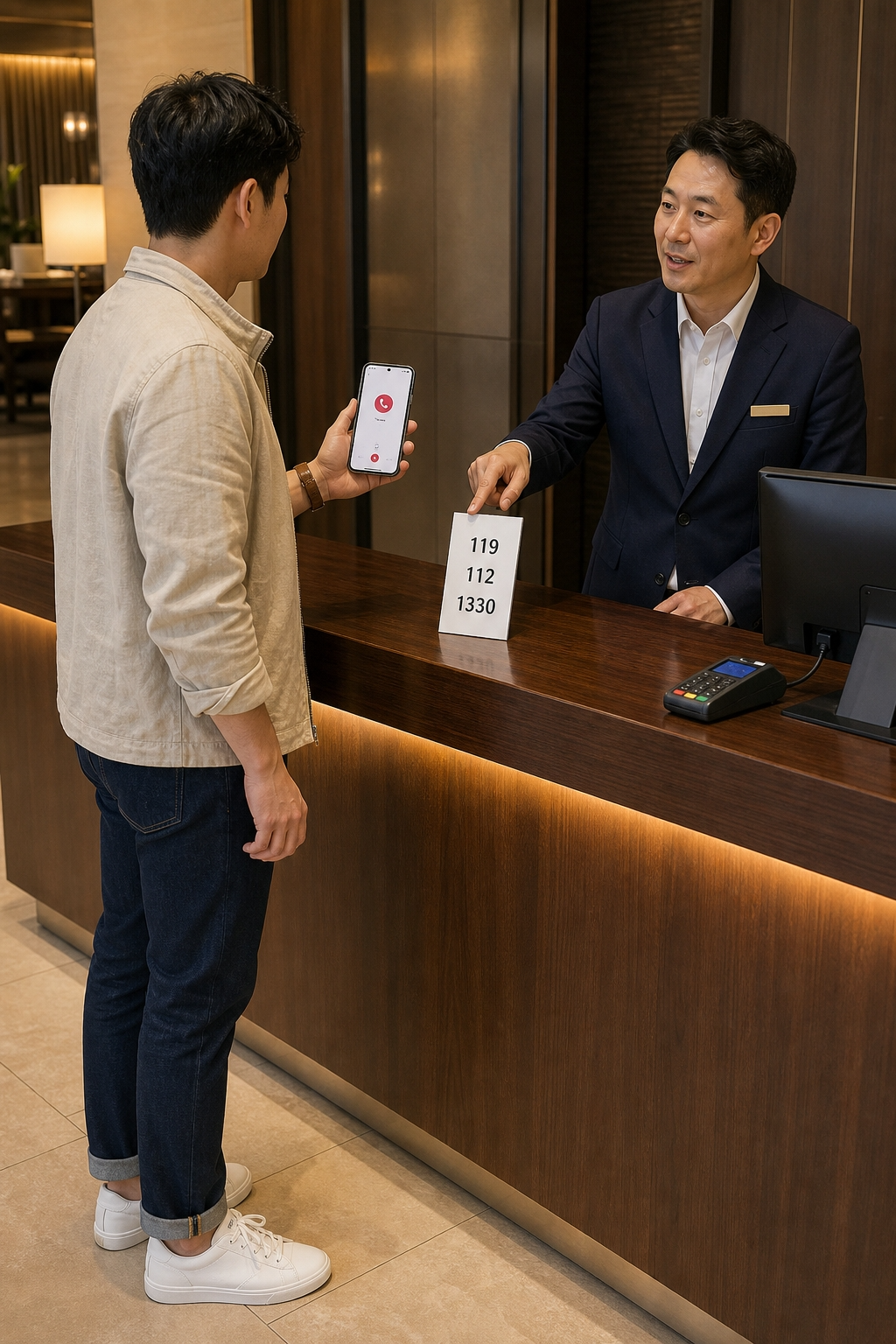
Emergency numbers are easy to ignore until the moment you need them.
When you are traveling in another country, knowing which number to call can make a stressful situation much easier to handle.
In Korea, three numbers are especially important for visitors:
- 119 — Ambulance, fire and rescue
- 112 — Police
- 1330 — Korea Travel Helpline and non-emergency travel assistance
Call 119 for an ambulance, fire, or rescue emergency. Call 112 when you need the police. Call 1330 when you need tourism information, language assistance, or help solving a non-life-threatening travel problem.
The numbers are short, but choosing the correct one matters.
A traveler who is seriously injured or struggling to breathe should not call a tourism helpline first. Someone facing theft, violence, or an immediate safety threat should contact the police.
This guide explains the most important emergency numbers in Korea, when to use each one, what information to provide, and how to prepare before something goes wrong.
Emergency Numbers in Korea: Quick Reference
Save these numbers before your trip:
- 119 — ambulance, fire, and rescue
- 112 — police
- 1330 — Korea Travel Hotline
- 1345 — immigration information
- 1366 — support for victims of domestic violence
- 182 — missing persons and lost-property police assistance
- 110 — government information and non-emergency public-service guidance
The three numbers most travelers should remember are 119, 112, and 1330.
For an immediate threat to life, health, or safety, use 119 or 112.
Call 119 for an Ambulance, Fire, or Rescue
Call 119 when someone needs urgent medical assistance, when there is a fire, or when rescue services are required.
Examples include:
- Severe difficulty breathing
- Chest pain
- Loss of consciousness
- Major bleeding
- Serious injury
- Seizure
- Severe allergic reaction
- Suspected stroke
- Traffic accident with injuries
- Fire or smoke
- A person trapped in a dangerous location
- A situation requiring urgent rescue
You do not need to know which nearby hospital to use. Explain the location and symptoms as clearly as possible, and the emergency service will determine the response.
Do not delay calling because you are worried about speaking Korean.
Start with a few simple English words:
“Ambulance, please.”
“Fire.”
“Medical emergency.”
Then provide your location.
What to Tell the 119 Operator
The most important information is:
- What happened
- The patient’s condition
- The exact location
- Whether the patient is conscious
- Whether the patient is breathing
- Your phone number
For example:
“Ambulance, please. A man has severe chest pain. He is conscious. We are at the lobby of ABC Hotel in Myeongdong.”
Do not give a long explanation before stating the emergency and location.
If you are inside a large building, provide:
- Building or hotel name
- Korean address
- Floor
- Room number
- Nearest entrance
- Nearby landmark
Ask someone to wait near the entrance and guide the responders when possible.
Call 112 for the Police
Call 112 when you need immediate police assistance.
Examples include:
- Violence or threats
- Theft or robbery in progress
- Sexual assault
- Stalking
- A dangerous confrontation
- A missing child
- A serious traffic incident
- Someone attempting to enter your room
- Suspicious activity involving an immediate safety risk
If your wallet or phone was lost but there is no immediate danger, first check nearby businesses, your hotel, a subway lost-and-found office, or the police lost-property system.
However, call 112 immediately when you feel unsafe or believe a crime is happening.
Move to a safe, public location whenever possible.
What to Tell the 112 Operator
State the problem and location first.
For example:
“Police, please. Someone stole my bag. I am outside Exit 5 of Hongik University Station.”
Useful information includes:
- What happened
- Whether the suspect is still nearby
- Whether anyone is injured
- Your exact location
- The direction the suspect went
- Clothing or identifying details
- Whether a weapon was seen
Do not follow or confront a suspected thief.
Preserve any useful evidence, including messages, photos, receipts, taxi information, or payment records.
What Is 1330?
The Korea Travel Hotline at 1330 is designed to help travelers with tourism information and certain language or travel-related problems.
It may be useful for:
- General tourism information
- Transportation questions
- Directions
- Interpretation support
- Communicating with a taxi driver
- Finding tourist services
- Reporting or discussing a travel inconvenience
- Finding information about nearby facilities
However, 1330 is not a replacement for the police, ambulance, or fire service.
Use 119 for urgent medical, fire, or rescue situations.
Use 112 for crime and immediate police assistance.
Use 1330 when the situation is not life-threatening and you mainly need travel information or communication support.
Do Not Call 1330 First During a True Emergency
This distinction is important.
Call 119 directly when:
- Someone cannot breathe
- Someone is unconscious
- There is severe bleeding
- A serious injury has occurred
- You see fire or heavy smoke
Call 112 directly when:
- Someone is attacking or threatening you
- A crime is taking place
- You are being followed
- Someone is attempting to enter your room
- You face an immediate safety threat
Calling a general assistance service first may waste valuable time.
When health or safety is in immediate danger, contact the appropriate emergency service without delay.
Can You Call Without Speaking Korean?
Yes. You should still call in an emergency, even if you do not speak Korean.
Use short sentences and basic English.
Avoid explaining your entire travel history.
Start with:
- “Ambulance.”
- “Police.”
- “Fire.”
- “I need help.”
- “I do not speak Korean.”
- “English, please.”
Then give the location.
A hotel employee, restaurant worker, station employee, or Korean-speaking person nearby may also help explain the situation, but do not delay an urgent call while searching for an interpreter.
Useful Korean Phrases
“도와주세요.”
Dowajuseyo.
Please help me.
“구급차 불러 주세요.”
Gugeupcha bulleo juseyo.
Please call an ambulance.
“경찰 불러 주세요.”
Gyeongchal bulleo juseyo.
Please call the police.
“불이 났어요.”
Buri nasseoyo.
There is a fire.
“사람이 다쳤어요.”
Sarami dachyeosseoyo.
Someone is injured.
“숨을 못 쉬어요.”
Sumeul mot swieoyo.
The person cannot breathe.
“의식이 없어요.”
Uisigi eopseoyo.
The person is unconscious.
“여기가 어디인지 모르겠어요.”
Yeogiga eodiinji moreugesseoyo.
I do not know where I am.
“영어 가능한 분 있나요?”
Yeongeo ganeunghan bun innayo?
Is there someone who speaks English?
“제 위치를 보내 드릴게요.”
Je wichireul bonae deurilgeyo.
I will send you my location.
How to Explain Your Location
An exact location is often more important than perfect Korean.
Before your trip, save your hotel’s:
- English name
- Korean name
- Korean address
- Phone number
- Naver Map or KakaoMap location
- Nearest subway station and exit
When you are outside, look for:
- Subway station name
- Exit number
- Building name
- Store name
- Road sign
- Bus-stop number
- Nearby landmark
Instead of saying:
“I am somewhere near a large road in Seoul,”
say:
“I am outside Gangnam Station Exit 10.”
Large apartment complexes may have several buildings, entrances, and towers. Provide the building number and meet responders at a clearly identified entrance when possible.
For help finding Korean addresses, read How to Use Naver Map and KakaoMap in Korea Without Getting Lost.
Use Your Smartphone Location
Your phone can help emergency responders or another person identify your location.
Open Naver Map, KakaoMap, or your current map app and check:
- Current address
- Nearby building
- Road name
- Subway station
- Entrance or exit number
Take a screenshot of the location if you need to send it to a hotel employee, friend, or interpreter.
Do not depend entirely on a data connection.
Save important addresses and emergency information offline before leaving your accommodation.
Ask Hotel Staff for Help
Hotel reception staff can be extremely helpful during an urgent but manageable situation.
They may be able to:
- Call 119 or 112
- Explain the address in Korean
- Speak with an operator
- Arrange a taxi to a clinic
- Locate a nearby police station
- Contact your travel companion
- Help explain what happened
- Preserve hotel security footage
However, hotel staff are not medical professionals and cannot replace emergency services.
For chest pain, breathing difficulty, unconsciousness, major injury, or another potentially life-threatening condition, call 119 immediately.
What to Do After Calling 119
While waiting for an ambulance:
- Follow the operator’s instructions
- Keep the phone available
- Unlock doors if safe
- Send someone to the entrance
- Keep the patient still unless there is immediate danger
- Gather identification and medication information
- Prepare allergy and medical-condition details
- Do not give food or drink to an unconscious person
Bring the patient’s passport, insurance information, phone, and medication list if they can be collected without delaying care.
What to Do After Calling 112
After contacting the police:
- Move to a safe location
- Avoid confronting the suspect
- Keep your phone charged and available
- Write down what happened
- Save screenshots and messages
- Keep receipts and transaction records
- Photograph damage when safe
- Ask witnesses for contact information
- Contact your embassy or insurer when appropriate
For lost payment cards, contact the card issuer immediately.
For a stolen passport, contact the police and your embassy or consulate.
Traffic Accidents
Call 119 when anyone is injured.
Call 112 when police assistance is needed, the accident is serious, the other party leaves, or there is a dispute involving safety.
Do not stand in an active traffic lane.
Move to a safe location when possible and follow instructions from emergency responders.
Take photos of:
- Vehicle positions
- License plates
- Damage
- Road conditions
- Nearby signs
- Insurance information
Do not sign a document you do not understand.
Ask for interpretation or contact your travel insurer when necessary.
Lost Phones, Wallets, and Passports
A lost item is not always a 112 emergency.
First check:
- The restaurant or cafe you visited
- Hotel reception
- Subway lost-and-found services
- Taxi records
- Nearby police station
- The card issuer’s transaction history
Call 112 when theft is occurring, you feel threatened, or immediate police help is necessary.
For a missing passport:
- Report the loss to police.
- Contact your embassy or consulate.
- Notify your airline if travel is soon.
- Keep copies of the police report.
- Contact your travel insurer.
Store a digital copy of your passport separately from the original.
Other Useful Numbers
1345 — Immigration Contact Center
This service can help with immigration-related information, including visas, entry, residence, and immigration procedures.
It is not an emergency police or ambulance number.
1366 — Support for Domestic Violence
This number is associated with support for people facing domestic violence and related safety concerns.
For immediate violence or danger, call 112 first.
182 — Police Assistance for Missing Persons and Lost Property
This may be useful for non-immediate police inquiries involving missing persons or lost property.
For a crime in progress or an immediate safety threat, call 112.
110 — Government Information
This number provides guidance about government services and public administration.
It is not a substitute for 112 or 119.
Prepare Before Your Trip
Save an emergency note on your phone containing:
- 119 — ambulance, fire, rescue
- 112 — police
- 1330 — travel information and interpretation support
- Passport number
- Travel insurance policy number
- Insurer’s emergency number
- Medication list
- Allergies
- Emergency contact
- Hotel’s Korean address
- Embassy or consulate details
Take screenshots so the information remains available without internet access.
Travel companions should know where this note is stored.
Common Mistakes Travelers Make
The first mistake is calling 1330 during a life-threatening medical emergency instead of calling 119.
The second is giving a long explanation before stating the location.
The third is describing a hotel only by an English nickname.
The fourth is failing to save the Korean address.
The fifth is ignoring calls from an unfamiliar Korean number after requesting help.
The sixth is confronting a suspected thief or aggressive person.
The seventh is waiting for a bilingual person before calling emergency services.
The eighth is forgetting to save insurance and embassy information offline.
The ninth is using 112 for a routine travel question that 1330 or hotel staff could handle.
Related Korea Compass Guides
For health problems, read What to Do If You Get Sick While Traveling in Korea.
For outpatient treatment, see How to Visit a Clinic in Korea as a Foreigner.
For medicines and prescriptions, read Korean Pharmacy Guide for Foreigners: Medicine, Prescriptions, and Useful Tips.
For essential communication, see Basic Korean Phrases for Travelers: What to Say in Real Situations.
For maps and addresses, read How to Use Naver Map and KakaoMap in Korea Without Getting Lost.
For official travel information, visit VisitKorea.
Korea Compass Note
The simplest emergency plan is the most useful:
119 for an ambulance, fire, or rescue.
112 for police.
1330 for non-emergency travel information and language assistance.
Save your hotel’s Korean address before leaving the building each morning.
During an emergency, say what happened, give your location, and answer questions as clearly as possible.
You do not need perfect Korean to ask for help.
Final Thoughts
Emergency numbers in Korea are easy to remember when you separate them by purpose.
Call 119 for medical emergencies, fire, and rescue.
Call 112 for police and immediate safety threats.
Call 1330 for tourism information, interpretation assistance, and non-life-threatening travel problems.
Prepare your Korean address, insurance information, medication list, and emergency contacts before your trip.
In an urgent situation, do not waste time searching for the perfect words.
Call the correct number, state the problem, and provide your location.