
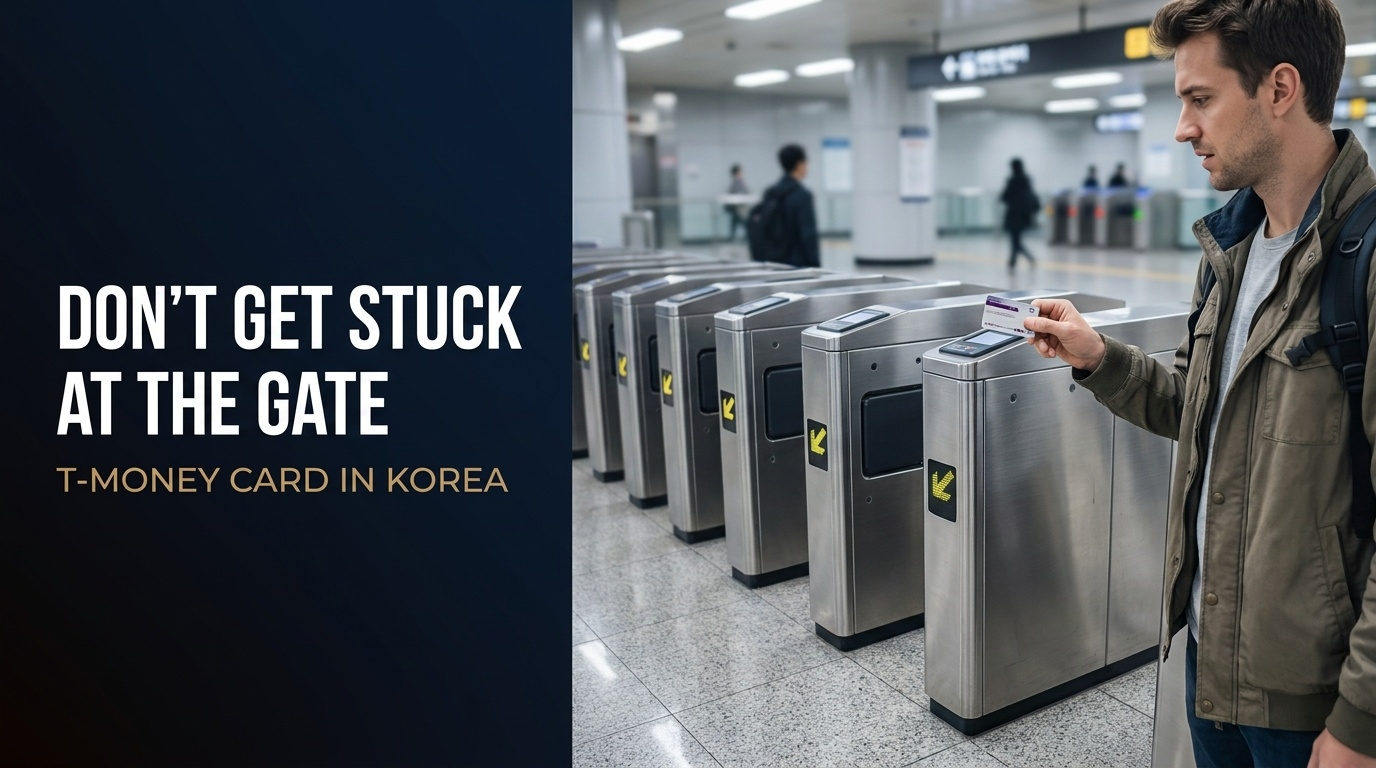
Your foreign Visa may buy coffee in Seoul—and still leave you standing at a subway gate.
Do not assume that tapping an overseas bank card will open an ordinary Korean subway gate. Most foreign visitors still need a T-money Card in Korea, a compatible mobile Tmoney card, or another local transportation pass.
The physical card remains the simplest option. However, international visitors can now use MobileTmoney on supported iPhones and Apple Watches, although the payment card used to add balance still matters.
Here is the practical answer before you reach the gate.
Quick Answer
A basic T-money Card in Korea usually costs about ₩3,000–₩5,000. The card price and transportation balance are separate, so you must add money after buying it.
For most tourists:
- Buy a physical T-money card at a convenience store or participating subway station.
- Add ₩10,000–₩20,000 as a starting balance.
- Keep Korean cash available for recharging.
- Tap when entering and leaving the subway.
- Tap when getting on and off a bus.
- Give every traveler a separate card.
- Do not assume that every foreign credit card can recharge every type of T-money card.
International users can also use MobileTmoney on compatible Apple devices. The app currently lists Mastercard, American Express, UnionPay and JCB for Apple Pay top-ups. Visa is not currently included in that list.
Which Transportation Card Should You Choose?
| Option | Best for | How to add value | Main limitation |
|---|---|---|---|
| Physical T-money card | Most first-time visitors | Korean cash; cards on select machines | Can be lost and requires separate balance |
| MobileTmoney on iPhone or Apple Watch | Travelers who prefer tapping a device | Supported cards through Apple Pay | Visa is not currently listed; device compatibility matters |
| Seoul Climate Card short-term pass | Frequent rides mainly within Seoul | Cash or international cards at supported machines | Coverage and validity are more limited than standard T-money |
If you want the least complicated option, buy a physical card. It works without an app, Korean phone number or charged phone battery.
What Is a T-money Card?
T-money is a rechargeable transportation card used across many Korean transit systems.
It can be used for:
- Subways
- City buses
- Many taxis
- Some convenience-store purchases
- Selected vending machines and lockers
Its main benefit is convenience. Instead of buying a separate subway ticket for every journey, you tap the card at the gate. The correct fare is deducted automatically.
Using the same card can also qualify you for transfer discounts between eligible buses and subways. The official Tmoney foreigner guide explains that transfer discounts depend on using the same card within the permitted transfer period.
Where Can You Buy a T-money Card in Korea?
The easiest place is usually a convenience store.
Look for:
- CU
- GS25
- 7-Eleven
- Emart24
- Other stores displaying the T-money logo
Cards are also available at some subway stations, airport transportation counters and vending machines.
Basic cards commonly cost around ₩3,000–₩5,000. Character cards, key rings and souvenir designs may cost more.
You can say:
“T-money card juseyo.”
티머니 카드 주세요.
“Please give me a T-money card.”
The purchase price normally covers only the physical card. It does not mean the card contains transportation balance.
The Mistake That Stops Tourists at the Gate
Many first-time visitors buy the card and immediately walk toward the subway.
Then the gate refuses to open.
The most likely reason is simple: they purchased the card but did not add any balance.
Before leaving the store, ask the staff to recharge it:
“Man won charge hae juseyo.”
만원 충전해 주세요.
“Please add ₩10,000.”
The cashier may collect the card price and top-up amount as separate payments. Check that the balance was added before heading to the station.
How Do You Recharge a Physical T-money Card?
You can recharge a physical T-money Card in Korea at convenience stores and subway recharge machines.
The official Tmoney guide instructs users to present the card with Korean won in cash at participating top-up locations. Some newer or selected subway machines may accept card payments, but acceptance is not universal.
The safest rule for visitors is:
Keep Korean cash available for a standard T-money recharge.
In March 2026, Seoul introduced 440 machines at 273 stations on Lines 1–8 that accept internationally issued Visa and Mastercard payments. However, the Seoul Metropolitan Government announcement specifically covers Climate Card short-term passes and single-journey tickets.
It does not mean that every machine now accepts a foreign card for every standard physical T-money top-up.
How Much Money Should You Add?
There is no need to load a large amount immediately.
A practical starting point is:
- ₩10,000 for light use
- ₩20,000 for several active travel days
- More only when your balance becomes low
Recharging is easy, so adding smaller amounts reduces the balance you need to refund before leaving Korea.
The card reader or gate screen normally displays your remaining balance after each tap.
How Do You Use T-money on the Subway?
Tap the card on the reader when entering the station. Tap it again when leaving at your destination.
The rule is simple:
- Tap in.
- Take the train.
- Tap out.
If the gate does not open, step aside and check the screen. The balance may be too low, or the reader may have detected another card in your wallet.
Do not place T-money directly beside another transportation card, hotel key or NFC-enabled bank card. Remove it from your wallet and tap it separately if the reader reports an error.
For more help with trains, exits and transfers, see our public transportation guide for first-time Korea visitors.
How Do You Use T-money on a Bus?
Tap the reader near the driver when boarding. Tap again near the rear door before getting off.
The second tap matters because it completes the trip and helps the system calculate eligible transfer discounts.
According to the Seoul public transportation guide, passengers should tap when entering and again at the rear-door reader when leaving.
Korean buses sometimes begin moving quickly. Secure your card, luggage and balance before boarding so you do not have to search through a bag beside the driver.
Can Two People Share One T-money Card?
Every traveler should have a separate card for normal subway and bus use.
Using one card for multiple travelers can interfere with transfers and fare calculations. It is especially inconvenient when two people need to enter or leave through separate subway gates.
The easiest rule is:
One person, one card.
This also makes it easier for each traveler to separate during the day without losing access to transportation.
Does Apple Watch Tmoney Work for Tourists?
Yes—but the setup is different from using a physical card.
The current MobileTmoney app allows international users to begin without membership registration. Its App Store listing says Apple Pay top-ups currently support:
- Mastercard
- American Express
- UnionPay
- JCB
Visa is not currently listed as a supported international MobileTmoney top-up network. Support can change, so check the app before traveling.
Apple also states that buying or topping up Tmoney directly inside Apple Wallet requires a South Korea-issued payment card. International visitors therefore need to follow the foreign-user process provided through MobileTmoney rather than assuming that any overseas Apple Pay card will work directly in Wallet.
A transit card can be active on only one Apple device at a time. If you move it from your iPhone to your Apple Watch, it cannot simultaneously be used from both devices.
Read our full setup and payment-card explanation in Apple Watch Tmoney in Korea: Can Tourists Finally Tap In?.
A physical card is still a sensible backup if your phone battery dies or the mobile setup does not accept your payment card.
T-money or Seoul Climate Card?
Choose T-money if:
- You are traveling beyond Seoul.
- You will take only a few rides each day.
- You want a flexible pay-per-ride card.
- You plan to use buses and subways in different Korean cities.
Consider a short-term Climate Card if:
- Most of your transportation will be within the participating Seoul network.
- You expect to ride frequently every day.
- The routes you need are included.
- The unlimited-ride value is lower than your estimated T-money fares.
The Climate Card is not automatically cheaper for every visitor. Compare the trip length, coverage area and expected number of rides first.
See our Seoul Climate Card 2026 guide before deciding.
Can You Refund the Remaining Balance?
Yes. The official Tmoney guide says refunds are available at participating Tmoney sales and top-up locations.
The balance is returned in Korean won, normally after a ₩500 service fee. The original purchase price of the card is not refundable.
Refund procedures and available locations can depend on the remaining balance. Partial refunds have additional restrictions, so visitors with a large balance should use an official Tmoney service center.
For a small remaining amount, another option is to spend it at a participating convenience store or keep the card for a future visit.
Why Is My T-money Card Not Working?
Check these common causes:
- The card was purchased but never recharged.
- The remaining balance is too low.
- Two contactless cards are touching the reader together.
- You are trying to use an overseas bank card instead of T-money.
- The mobile transit card is active on another Apple device.
- Your phone battery is dead.
- You did not complete the previous tap correctly.
- The card itself is damaged.
If the subway gate displays an error, do not force it open. Use a recharge machine or ask staff at the information desk.
Frequently Asked Questions
Can a tourist recharge a physical T-money card with Visa?
Sometimes a card may work at a selected machine, but international-card acceptance is not universal for standard T-money recharging. Korean cash remains the most reliable option. The newer international-card machines announced by Seoul specifically support Climate Card short-term passes and single-journey tickets.
Can I tap my foreign bank card directly at a subway gate?
Do not depend on it. Korea has been expanding contactless and open-loop payment options, but ordinary gate compatibility is not yet something every foreign visitor should assume. Carry a physical T-money card or a properly configured mobile Tmoney card.
Does Apple Watch work instead of a physical T-money card?
Yes, on a compatible device after MobileTmoney is set up correctly. Check whether your Apple Pay payment card is supported and remember that the transit card can be active on only one Apple device at a time.
Should I buy T-money at the airport?
Buying it at the airport is convenient if you plan to use public transportation immediately. Convenience stores and participating subway locations in the city are also easy options.
Can I use T-money outside Seoul?
T-money is accepted across many major Korean public transportation systems, but local exceptions can exist. It is more flexible for nationwide travel than a Seoul-only short-term pass.
Korea Compass Note
A T-money card is simple once it has balance.
The problems usually happen before the first ride: buying a card without recharging it, assuming every overseas payment card will work, or keeping several NFC cards together in the same wallet.
Buy the card, add a modest balance and keep a small amount of Korean cash available.
Then remember the only habit that really matters:
Tap in. Tap out.
Information checked on August 25, 2026. Payment networks, mobile-app support and transit policies can change. Confirm current conditions through Tmoney, Apple or the Seoul Metropolitan Government before travel.