
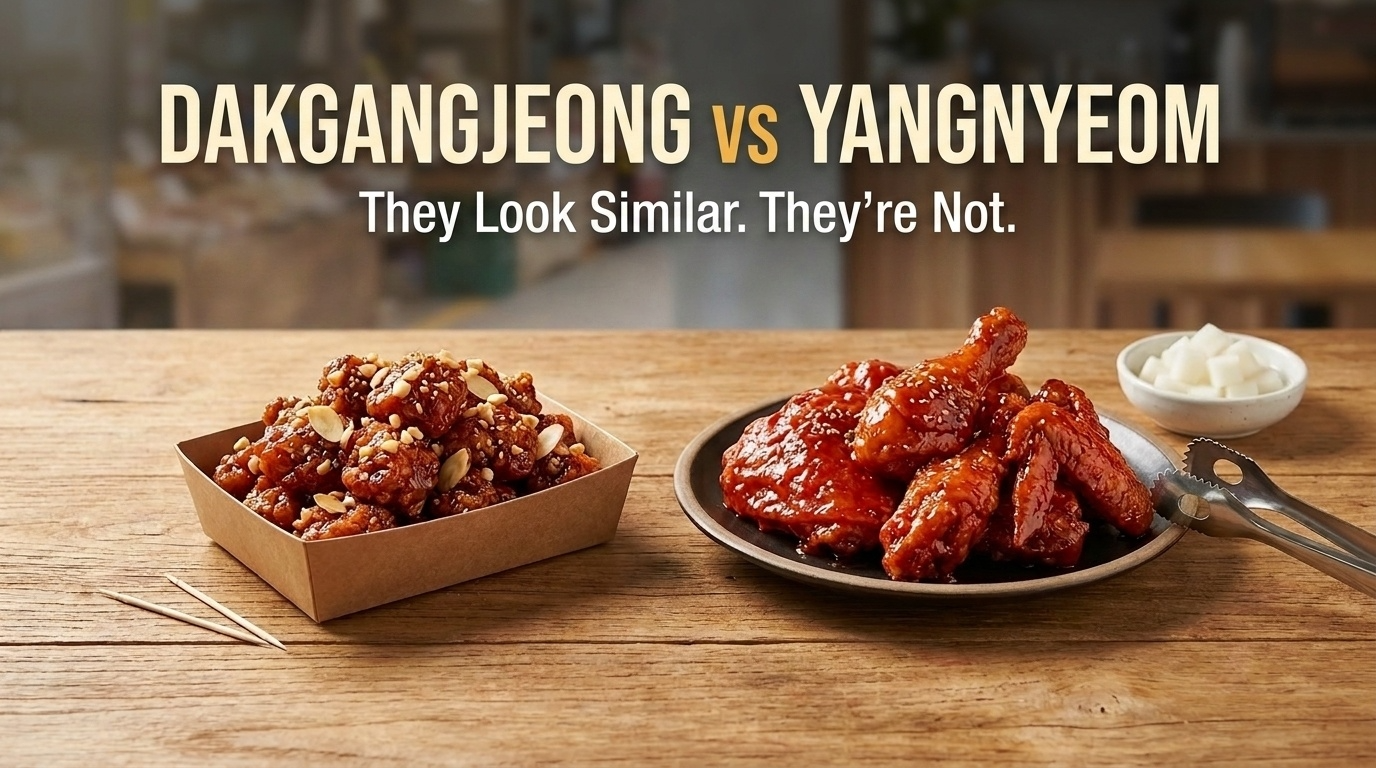
You order sweet and spicy Korean chicken at a traditional market and receive small, crispy pieces covered in a shiny, sticky glaze.
The next evening, you order what appears to be the same dish from a Korean fried chicken restaurant.
This time, larger wings and drumsticks arrive covered in a softer, saucier coating.
Both are fried. Both can be sweet and spicy. Both may appear red and glossy.
But they are not necessarily the same dish.
The difference between dakgangjeong vs yangnyeom chicken involves more than the name. Their texture, chicken cuts, sauce, serving style and even the situations in which Koreans eat them can be different.
If you are still learning the wider Korean chicken menu, start with our Korean Fried Chicken Guide before comparing these two popular styles.
The Quick Answer
Dakgangjeong generally consists of smaller fried chicken pieces coated in a thick, sticky glaze. It is frequently sold as a traditional-market snack or takeout food and often remains enjoyable after it cools.
Yangnyeom chicken is Korean fried chicken covered in a sweet, spicy and savory sauce. It is commonly ordered from a fried chicken restaurant as a hot meal, often alongside plain fried chicken.
Here is the simplest comparison:
| Feature | Dakgangjeong | Yangnyeom Chicken |
|---|---|---|
| Typical size | Small, bite-sized pieces | Wings, drumsticks or larger boneless pieces |
| Sauce | Thick, sticky and glaze-like | Usually softer, wetter and more generous |
| Texture | Firm and relatively crunchy | Crispy when fresh but softens in the sauce |
| Bones | Often boneless, but not always | Bone-in and boneless options are common |
| Where sold | Markets, snack shops and takeout stalls | Chicken restaurants and delivery apps |
| How it is eaten | Snack, street food or takeout | Shared meal, often with beer |
| Best temperature | Frequently good warm or at room temperature | Usually best served hot |
These are common patterns rather than strict rules.
Recipes vary by region and restaurant. Some businesses also use the names loosely, so two products with different names may occasionally look quite similar.
What Is Dakgangjeong?
The Korean word dak means chicken.
Gangjeong refers to a traditional style of coating or glazing food with a sweet, sticky mixture.
Dakgangjeong normally consists of fried chicken pieces coated in a glossy sauce made with ingredients such as:
- Gochujang or chili sauce
- Soy sauce
- Garlic
- Sugar, corn syrup or rice syrup
- Vinegar
- Sesame seeds
- Peanuts, almonds or other nuts
The pieces are often small enough to eat with a toothpick or disposable fork.
Many market vendors use boneless meat, particularly for bite-sized versions. However, travelers should not assume all dakgangjeong is boneless. Some regional variations and famous market versions contain bones.
One of dakgangjeong’s defining characteristics is its firm coating.
The glaze clings closely to the fried exterior instead of collecting at the bottom of the container. A well-prepared version can remain sticky, chewy and relatively crisp after cooling.
This makes it particularly convenient for:
- Walking through a traditional market
- Taking back to a hotel
- Eating during a train journey
- Sharing as a snack
- Buying as a regional food souvenir
- Taking home after a trip
At Korean markets, dakgangjeong may be displayed in cups, trays or boxes instead of being cooked only after each order.
What Is Yangnyeom Chicken?
The word yangnyeom means seasoning or seasoned sauce.
Yangnyeom chicken begins with Korean fried chicken. A sweet, spicy and savory sauce is added after the chicken has been fried.
The sauce commonly includes some combination of:
- Gochujang
- Chili sauce
- Ketchup
- Garlic
- Soy sauce
- Sugar or another sweetener
Yangnyeom chicken may be served as:
- Wings
- Drumsticks
- Mixed bone-in pieces
- Boneless chicken
- A whole or half chicken cut into portions
Compared with dakgangjeong, its sauce is often looser and applied more generously.
The result is typically softer and saucier, particularly if the chicken remains inside a closed delivery box for an extended period.
Yangnyeom chicken is closely associated with Korea’s fried chicken restaurants, late-night delivery culture and chimaek—the popular pairing of chicken and beer.
A common order is banban, meaning half-and-half. One half of the box contains plain fried chicken, while the other contains yangnyeom chicken.
The Korea Tourism Organization describes yangnyeom chicken as deep-fried chicken coated in a sweet and spicy sauce.
Planning to order chicken to your hotel or apartment? Read Can Foreigners Order Food Delivery in Korea? before opening a Korean delivery app.
Seven Differences Between Dakgangjeong and Yangnyeom Chicken
1. Dakgangjeong Is Usually Smaller
Dakgangjeong is commonly served in small, bite-sized pieces.
Yangnyeom chicken is more likely to use recognizable wings, drumsticks or larger boneless pieces.
This is often the easiest visual clue when comparing dakgangjeong vs yangnyeom chicken.
2. The Coating Feels Different
Dakgangjeong normally has a thicker and stickier coating. It may look almost caramelized around the fried exterior.
Yangnyeom chicken generally has more sauce. Depending on the restaurant, that sauce can be glossy and sticky or relatively soft and wet.
3. Dakgangjeong Holds Its Texture Longer
Dakgangjeong is often prepared with takeout and room-temperature eating in mind. Its coating tends to remain firm longer.
Yangnyeom chicken is usually at its best shortly after cooking. As it sits, the sauce gradually softens the fried coating.
That does not make one version better. It simply means they suit different situations.
4. Yangnyeom Chicken Is More Often a Full Meal
A large box of yangnyeom chicken is normally treated as a meal to share.
It may arrive with:
- Cubed pickled radish
- Dipping salt
- Canned drinks
- Disposable gloves
- A chicken fork or tongs
Dakgangjeong is frequently treated as a market snack, although a large box can certainly become a meal.
5. Neither One Is Automatically Very Spicy
The red color can worry visitors who do not tolerate spicy food.
However, some dakgangjeong is sweeter than it is spicy, particularly versions aimed at children or tourists. Other versions contain dried chili peppers and have a noticeable kick.
Yangnyeom chicken also ranges from mild and sweet to extremely spicy.
Look for these Korean expressions:
- 순한맛 (sunhanmat): mild
- 보통맛 (botongmat): regular
- 매운맛 (maeunmat): spicy
- 아주 매운맛 (aju maeunmat): very spicy
Ask before ordering if spice level matters to you.
6. They Are Commonly Sold in Different Places
You are especially likely to find dakgangjeong at:
- Traditional markets
- Street-food areas
- Highway rest stops
- Small takeout shops
- Tourist food streets
Yangnyeom chicken is more closely associated with:
- Korean fried chicken chains
- Neighborhood chicken restaurants
- Delivery apps
- Pubs
- Late-night takeout
There is overlap. A chicken restaurant may offer dakgangjeong, while a market stall may sell something resembling boneless yangnyeom chicken.
7. Nut Toppings Are More Common on Dakgangjeong
Dakgangjeong is frequently topped with:
- Peanuts
- Sliced almonds
- Sunflower seeds
- Sesame seeds
Yangnyeom chicken may have sesame seeds, but larger nut toppings are generally less central to the dish.
Anyone with an allergy should ask about ingredients. The sauce may also contain soy and wheat even when those ingredients are not visible.
Famous Places to Try Dakgangjeong in Korea
If you want to compare the real dish rather than relying on a convenience-store version, two names frequently appear in Korean travel conversations.
Sinpo Dakgangjeong in Incheon
Sinpo International Market is one of Korea’s best-known destinations for dakgangjeong.
The Korea Tourism Organization identifies dakgangjeong as the market’s most famous food. The well-known Sinpo variation described in the official tourism guide uses bone-in chicken and has a distinctly sweet and spicy flavor.
This is important because many international visitors assume that every serving of dakgangjeong is boneless.
Sinpo International Market is located in Incheon. It is accessible from Sinpo Station, Dongincheon Station and Incheon Station.
Several food businesses operate inside and around the market. Check the individual shop name instead of assuming that every box comes from the same vendor.
See the official VISITKOREA guide to Sinpo International Market before visiting, as individual shop hours can vary.
Mansuk Dakgangjeong in Sokcho
Mansuk Dakgangjeong is strongly associated with Sokcho, a popular coastal destination in Gangwon Province.
Travelers commonly buy a box during a Sokcho trip and take it back to their hotel or home.
The company’s official website lists locations including its Expo main store and a shop in the Sokcho Tourism and Fishery Market area. Store availability and operating information may change, so check the official Mansuk Dakgangjeong website before visiting.
Although the brand has operated a location in Gangneung, its identity and best-known stores are associated with Sokcho.
Because dakgangjeong generally holds its texture longer than freshly sauced fried chicken, it works particularly well as a regional takeout food.
If market food is part of your trip, our Myeongdong Street Food Guide explains what else to try and what tourists should expect.
This article is not sponsored. Brand and market names are included as familiar examples for travelers. Menus, prices, locations and operating hours may change.
Which One Should You Order?
Choose dakgangjeong if you want:
- A portable market snack
- Small, easy-to-share pieces
- A firmer and stickier coating
- Chicken that will still taste good later
- Something convenient to eat without a full table setting
- A regional takeout specialty
Choose yangnyeom chicken if you want:
- A complete Korean fried chicken meal
- Wings or bone-in chicken
- A softer and saucier coating
- Chicken delivered hot
- A meal to share with friends or family
- Chicken to enjoy with beer
If you are trying Korean chicken for the first time, consider eating the two dishes on different occasions.
Dakgangjeong works particularly well during a traditional-market visit. Yangnyeom chicken makes more sense for an evening meal or hotel delivery.
Useful Ordering Phrases
For useful expressions beyond ordering chicken, see Basic Korean Phrases for Travelers.
Is this boneless?
이거 순살이에요?
Igeo sunsarieyo?
Is it spicy?
이거 매워요?
Igeo maewoyo?
Please give me the mild version.
순한맛으로 주세요.
Sunhan mat-euro juseyo.
One small box, please.
작은 것 하나 주세요.
Jageun geot hana juseyo.
Does this contain peanuts?
땅콩 들어가요?
Ttangkong deureogayo?
The word 순살 (sunsal) generally indicates boneless meat.
Even when ordering sunsal, eat carefully. Small bone fragments can occasionally remain during food preparation.
Why You May See “Gangjung” Online
Some Google users search for:
- Gangjung vs yangnyeom
- Gangjeong chicken
- Korean sweet crispy chicken
- Sweet Korean fried chicken
The standard spelling you will most commonly see is dakgangjeong.
Useful Korean and English search terms include:
- 닭강정
- Dakgangjeong
- 양념치킨
- Yangnyeom chicken
- Korean seasoned fried chicken
Searching with the Korean spelling in Naver Map or KakaoMap may reveal more neighborhood shops than searching only in English.
The Bottom Line
The easiest way to understand dakgangjeong vs yangnyeom chicken is this:
Dakgangjeong is generally smaller, firmer, stickier and more portable. It is commonly associated with traditional markets and takeout.
Yangnyeom chicken is generally larger, softer, saucier and intended to be eaten hot as a shared meal.
The definitions can overlap, and every restaurant has its own recipe. However, the size of the pieces, thickness of the sauce and place where the chicken is sold will usually tell you what to expect.
If you are standing in a Korean market holding a box of sticky bite-sized chicken, it is probably dakgangjeong.
If a delivery rider brings a large box of saucy wings and drumsticks to your door, it is probably yangnyeom chicken.
Either way, keep the pickled radish nearby.
Which One Would You Choose?
Have you tried both dakgangjeong and yangnyeom chicken in Korea?
Which one did you prefer—and was the dakgangjeong boneless or bone-in?
Share your experience below. Please avoid posting personal contact information or promotional links.
Personally, I like Mansuk the best. I’ve tried a few others, but that’s the one I’d buy again. What’s your favorite? – Michael